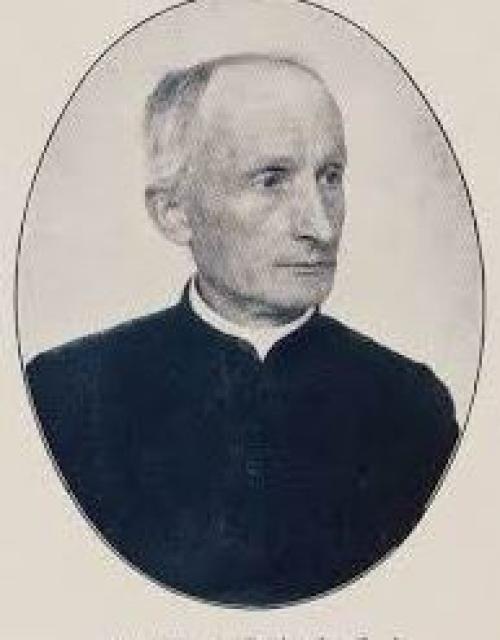
Victor Cathrein
 Switzerland
Victor Cathrein was a Swiss Jesuit priest whose books on moral philosophy, natural law, and socialism circulated widely in Catholic intellectual life around the turn of the twentieth century. Born on 8 May 1845 in Brig, in the canton of Valais, he spent nearly five decades teaching and writing. His work sought to show that ethical duties and legal rights rested on enduring principles grounded in human nature, rather than changing custom or state authority.
Formation and Exile
Cathrein was the son of a local government official and ironware merchant. After attending the college in Brig, he entered the Society of Jesus in 1863 at Gorheim, near Sigmaringen in what is now Germany. His training followed the order’s traditional course in philosophy and theology, but the path was interrupted by the Franco-Prussian War: he served in hospital care in Koblenz. When the Jesuits were expelled from the German Empire in 1872, he completed his theological studies in the Netherlands and England. He was ordained a priest in 1877.
The expulsion shaped the geography of his career. Cathrein taught at Jesuit seminaries in the Netherlands, first at Blijenbeek, then Exaeten, and finally Valkenburg. From 1882 to 1910 he taught moral philosophy and natural law, preparing generations of Jesuits while publishing in German and Latin. His Latin manual, Philosophia moralis, brought his lectures to a broader readership, particularly in Catholic circles beyond German-speaking Europe.
Ethics, Law, and Society
Cathrein’s central intellectual project was to defend a moral order that he believed was universal and knowable. He drew on the scholastic tradition, especially neo-Thomist thought, to argue that right and wrong could not be reduced to social convention, scientific positivism, or the decisions of governments. In his view, law also had a foundation before the state: legitimate legal systems should recognize rights arising from human nature.
His major work, Moralphilosophie, appeared in two volumes in 1890 and 1891 and was later expanded and reworked. The book offered a systematic account of ethical and legal duties and became an influential Catholic reference for decades. Another major project, Die Einheit des sittlichen Bewusstseins der Menschheit (The Unity of the Moral Consciousness of Humanity), published in three volumes in 1914, drew on historical and ethnographic material to argue that basic moral judgments were shared across cultures. Cathrein used this claim against theories that treated morality as entirely changeable through evolution or social development.
Socialism was another sustained concern. His book Der Sozialismus (Socialism), published in 1890, examined the movement’s principles and practical proposals, including its challenge to private property. The work went through many editions and was translated into several languages, helping establish him as a prominent Catholic critic of socialism. He also wrote on criminal law, international law, freedom of conscience, and the “woman question,” applying his ethical framework to issues of law and social reform.
Cathrein’s writing had a clear political and religious standpoint. He defended Catholic moral teaching and rejected the separation of ethics from religion. His opposition to socialism and his conservative commitments limited his engagement with the rapid changes of his era; the Swiss Historical Dictionary notes that his isolation in Dutch exile also made it harder for him to stay connected with evolving social realities. Even so, his sustained work on natural law made him a leading Catholic moral philosopher of his generation.
Later Years and Legacy
Released from teaching in 1910, Cathrein remained in Valkenburg as a writer into old age. His later publications included works on Christian humility, spirituality, and the moral character of pleasure, alongside his continuing interest in ethics and social thought. He died in Aachen on 10 September 1931, aged 86.
Cathrein’s legacy lies in the clarity and reach of his system. He gave Catholic readers a detailed defense of natural law at a time when positivist theories of morality and law were gaining influence, and his arguments on socialism entered debates far beyond the classroom. Today, his books are also valuable as records of how Catholic thinkers tried to answer modern political and intellectual movements from within an older tradition of moral philosophy.