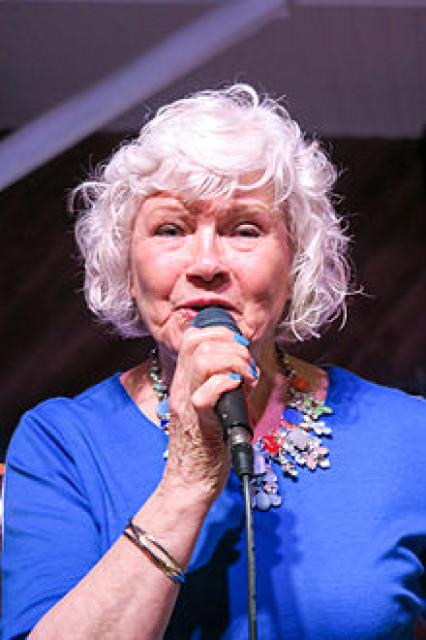
Vieno Kekkonen-Sauri
 Finland
Vieno Kekkonen became one of Finland’s best-known popular singers of the 1950s and 1960s, bringing a bright voice and a cosmopolitan mix of melodies to a rapidly changing music scene. She moved easily from Italian tunes and American standards to Finnish-language adaptations, while television and live appearances kept her in front of audiences for decades. Her first recording appeared in 1955; six decades later, she was still performing on concert stages.
A childhood performer finds her voice
Kekkonen was born in Karttula, Finland, on September 6, 1934. She first sang in public at the age of seven and later gained stage experience through theatre studies. As a student, she performed at a Savonian student gathering after entertainer Spede Pasanen encouraged her to sing. That appearance led to an audition with the Musiikki-Fazer record company and opened the door to a recording career.
Her debut record, “Nukkumatti” (“Mister Sandman”), came out in 1955. Soon she was recording songs that helped define Finnish entertainment music in the postwar years. Her version of “Tie,” based on Nino Rota’s “Gelsomina” from Federico Fellini’s film “La Strada,” became her first hit. She also made popular Finnish adaptations of “Yellow Rose of Texas,” “Over the Rainbow” and “Autumn Leaves,” alongside songs from Italy and other parts of the world.
The bright sound of Finnish popular music
Kekkonen emerged alongside singers such as Annikki Tähti and Brita Koivunen, at a moment when translated hit songs were gaining a strong foothold in Finland. Her recordings gave international melodies a new Finnish life, often with an easy swing and a polished, melodic style. Songs including “Preerian keltainen ruusu” (“The Yellow Rose of the Prairie”) and “Sateenkaaren tuolla puolen” (“Over the Rainbow”) became part of her lasting repertoire.
Her work was not confined to records. Kekkonen appeared regularly on music programs in the 1960s, including “Suuri sävelparaati” and “Iskelmäkaruselli pyörii,” and entertained audiences in restaurant floor shows. She also joined a trio of celebrated 1950s singers with Brita Koivunen and Pirkko Mannola, bringing their familiar voices together for concert audiences.
Six decades on stage
Kekkonen’s career stretched well beyond her first wave of hits. Yle described her in 2014 as still performing at age 80, with a voice she continued to use in the same keys as in her youth. She spoke of learning new songs and enjoying fresh concert programs, a curiosity that helped keep the stage inviting long after her early chart successes.
Known professionally by the surname Kekkonen and also recorded under the name Vieno Sauri, she remains a distinctive figure in Finnish popular music. Her story captures a turning point when international pop, local language and live television came together—and one singer found a place in all three.


