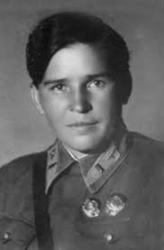
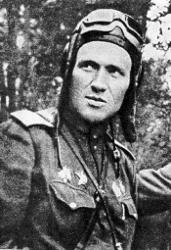
Vitaliy Primakov
 Ukraine
Biography of Vitaly Primakov
Vitaly Primakov was a Soviet military figure and commander of the Red Cossacks during the Russian Civil War. He held the rank of Komkor (1935). Born in 1914, he joined the Russian Social Democratic Labour Party in the same year and became a Bolshevik. Primakov, the son of a teacher, was sentenced to lifelong exile in Eastern Siberia in 1915 for evading military service while still a student in gymnasium. He was released following the February Revolution and became a member of the Kyiv Committee of Bolsheviks.
Military Career
As a delegate of the Second All-Russian Congress of Soviets, Primakov commanded a detachment during the October Revolution and participated in the storming of the Winter Palace. He also led the Red forces in suppressing General P.N. Krasnov's uprising near Gatchina. In January 1918, he formed the 1st Regiment of the Red Cossacks using disarmed Ukrainian Boguslav and Tarascha regiments, as well as other Cossack units that switched sides to the Reds. The regiment soon became a division.
From October 1920, Primakov served as the commander of the 1st Corps of the Red Cossacks. He was awarded two Orders of the Red Banner (in 1920 and 1921) for his actions in the battles near Orel and Kursk, as well as his successes in the Soviet-Polish War. Primakov was known for maintaining discipline through punitive measures, including the extrajudicial execution of several individuals suspected of involvement in pogroms in Kiev in 1922. He received his education at the Higher Military Academy (1923).
From 1924 to 1925, Primakov served as the chief of the Higher Cavalry School in Leningrad. In 1925-26, he was a military advisor to the 1st National Army in China. In 1927, he became a military attaché in Afghanistan and was known as the "Ragib-bey advisor" during the pro-Soviet rule of Amanullah Khan. Primakov advocated for the use of chemical weapons against rebellious tribes.
In 1930, he became a military attaché in Japan, and from 1931 to 1933, he commanded a corps. From 1933 to 1935, Primakov served as the deputy commander of the North Caucasus Military District and the deputy inspector of higher military educational institutions. In 1935, he became the deputy commander of the Leningrad Military District. On August 14, 1936, he was arrested at his dacha. His adjutants overpowered the NKVD operatives during the first attempt to arrest him on a train and handed them over to the local police at the nearest station.
During the investigation of the military case, Primakov was subjected to brutal torture. He provided testimonies that later led to the arrest of many commanders and commissars, including A.I. Gekker, B.S. Gorbachev, I.S. Kutjakov, and others. He confessed to participating in anti-Soviet, Trotskyist, and military-fascist conspiracies. Alongside M.N. Tukhachevsky, I.E. Yakir, and I.P. Uborevich, he was sentenced to death in a trial held with the special presence of the Supreme Court of the USSR on June 11, 1937. Primakov was executed.
He was posthumously rehabilitated in 1957. Primakov was married three times, with his second marriage being to the daughter of Ukrainian literary classic Mykhailo Kotsiubynsky, and his third marriage to Lila Brick.