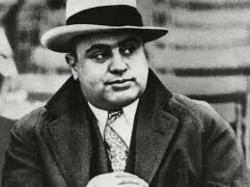
Vito Dzhenoveze
 USA
USA- Biography of Vito Genovese
- Moretti's death was a giant step for Genovese on his path to power.
- On October 26, 1957, Albert Anastasia was killed in a barbershop.
Biography of Vito Genovese
Vito Genovese, the head of the Genovese crime family, was known as the "King of Racketeering." He was frequently arrested in the 1920s on various charges but was only convicted twice, both times for illegal possession of firearms. The first time, at the age of 20, he served two months in a correctional facility. The second time, he was fined $250.
Vito Genovese was born in the suburbs of Naples in 1897. At the age of 16, he moved to the United States. He initially operated in Greenwich Village. In 1924, he got married, but his wife passed away in 1929. Later, he met the love of his life, Anna Petillo, who was married to someone else. Soon after, Anna's husband was killed under favorable circumstances for Vito. Two weeks later, Vito and Anna got married, with witnesses being Anthony Strollo - Tony Bender and his wife. According to Valachi, Anna's husband was killed by Peter Mione - Petey Maggins and Michael Barrase, on the orders of Genovese. (1932)
Feeling that the prosecutor Thomas Dewey would be able to put him behind bars, Don Vito decided to go on the run. In 1937, with two suitcases filled with $750,000, Genovese appeared in Italy, where he successfully began a new life. He collaborated with Mussolini, controlling the delivery of pure heroin for Mussolini's son-in-law, Count Ciano, the Minister of Foreign Affairs.
After the landing of the American troops (which took place with the active participation of Charlie Luciano), Don Vito switched sides and took on the role of an advisor. Being in a close relationship with the new authority, Genovese was given "official permission" to steal, and steal a lot. However, after some time, the administration realized the extent of his power and the machinations that were happening under his blessing. As a result, he was forced to relocate from Italy to America. On May 14, 1945, the steamship carrying Vito Genovese departed from Naples.
The situation seemed gloomy for Don Vito. He was expelled from Italy, where he had established an excellent business in narcotics and black market operations. In the United States, where he had been "king" for a whole twelve months, he was facing a murder charge. The situation seemed hopeless. However, for the boss of Cosa Nostra, it was not. Once Vito arrived in the "New World," he was arrested by the police, and a court decision was made to keep him in custody without bail. However, his lawyer, George Wolf, managed to secure his release on bail in the amount of $100,000.
The case was closed. All witnesses mysteriously died. District Attorney Hogan asked the court to drop the charges. Having resolved his issues with the U.S. authorities, Vito set out to regain control of Cosa Nostra.
Genovese was absent from the country for about eight years. Power in the family was transferred to the talented politician Frank Costello.
Vito Genovese realized that regaining his former power would take months, if not years. Going to war against Costello, who had someone like Willie Moretti under his command, meant complete defeat and the loss of a significant portion of his finances and authority. Therefore, Genovese searched for any reason to remove William Moretti from the picture. And that reason presented itself. Moretti contracted syphilis, and the disease had progressed to the point where it affected his brain. As a result, Moretti became too talkative and occasionally lost awareness of what he was saying. He could have compromised the entire organization (not through his own fault, of course). So, he was decided to be eliminated. John Robilotto was appointed as the executor. In June 1952, he was arrested by the police on suspicion of murder. An investigation was conducted, but the case was closed due to lack of evidence.
Moretti's death was a giant step for Genovese on his path to power.
However, Costello continued to hold the position of boss for another six years. He retired, clearing the way for Don Vito, only after surviving a gunshot to the head in front of his apartment building on May 2, 1957, after a late dinner at a Manhattan restaurant.
Taking over as the boss, Genovese immediately looked at the Mangano family and its boss, Albert Anastasia, whom he had despised his whole life. One of the reasons why Vito Genovese wanted to eliminate Albert Anastasia was the rumors he had heard that Anastasia and Costello were planning to get rid of him and asking Costello to return to the family as Don Vito.
However, Costello contacted Anastasia's capo, Carlo Gambino, informing him that if he went against his boss, after successfully completing the operation, Gambino could become the new head of the family. Genovese also involved his associate, Joseph Biondo (Joe Bandy).
In this planned operation, Vito Genovese combined two things - the pleasure and the usefulness. The pleasure for him was the elimination of Anastasia, whom he had hated his entire life. And the usefulness was the fact that Genovese could put his own person in charge of another New York family. The reason for this was clear. Don Vito officially controlled one family but actually influenced the other family, Cosa Nostra.
On October 26, 1957, Albert Anastasia was killed in a barbershop.
Without much fanfare, Carlo Gambino took over the leadership of the powerful family, whose influence under Anastasia had spread throughout the country.
Vito Genovese wasted no time - he prepared for his "coronation." For this, he called for a meeting of the "Syndicate," to which the heads of all the families in the country were supposed to attend. Initially, the meeting was planned to take place in one of the major hotels in Chicago, but the opinion of Stefano Magaddino - the leader of the Buffalo faction, prevailed. He suggested meeting at his assistant's estate, located outside the city, in a place called Apalachin.
However, the meeting was not meant to happen, as an observant New York Police Sergeant, Edgar D. Croswell, noticed a colossal number of luxurious cars forming a convoy and heading in the same direction. Almost all the bosses were detained and photographed.
In 1950, there was a divorce case in which Anna - his wife testified against Vito. The issue was that Don Vito was not faithful to his wife and even had affairs with her friends. Eventually, Anna got tired of it and filed for divorce. During the trial, her testimony was used by the FBI. It was decided to put Genovese behind bars for narcotics trafficking (although he had already ceased this activity).
The main witness in the case was Nelson Cantellops, a Puerto Rican who was serving a five-year sentence at Sing Sing prison for drug operations.
In July 1958, Genovese and twenty-three members of his group were indicted for conspiracy to distribute narcotics. The trial was scheduled for the spring of 1959.
Anna revealed the extent of her husband's wealth to the world. She stated in court that her husband made forty thousand dollars a week from the lottery alone. However, the defense lawyers managed to negotiate that Genovese would only have to pay three hundred and fifty dollars a week, plus Anna's lawyer fees.
The situation was different in the narcotics trafficking trial. Vito Genovese and fourteen of his accomplices were convicted. Nine other accomplices evaded justice. Genovese personally received a fifteen-year prison sentence.
It is worth noting that he did not order the killing of his ex-wife, Anna, even though she was the cause of all his troubles. Don Vito took a different approach: "If you want revenge, kill the brother of your enemy." This "brother" turned out to be a certain Steve Franze, whom Vito left his wife under the care of when he fled to Italy. It was evident that Steve had fulfilled his duties, even in Anna's bedroom during all the years her husband was absent, and their relationship did not end with his return.
By the time Vito Genovese was behind bars, he managed to get his revenge on his unfaithful wife.
The "King of Racketeering" spent ten years behind bars and awaited the consideration of a petition for early release. However, he did not live to receive a response. Genovese died in prison in 1969.