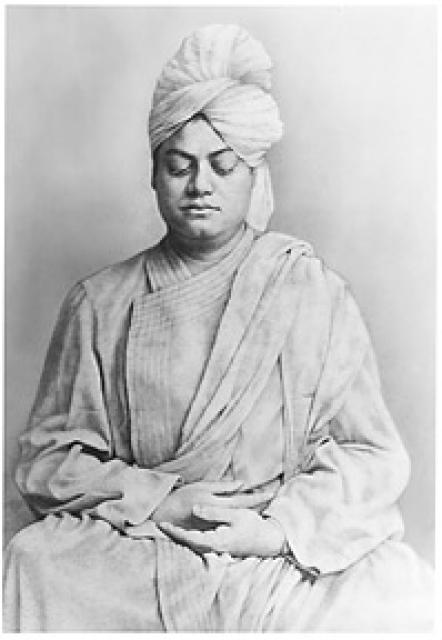
Vivekananda
 India
IndiaBiography of Swami Vivekananda
Swami Vivekananda, born on January 12, 1863 in the Shimla region of Calcutta (West Bengal), was an outstanding Indian philosopher and social activist. He practiced meditation from an early age and showed excellent academic and athletic skills in school. He organized an amateur theater studio and a gymnastics club, and took lessons in fencing, wrestling, rowing, and other sports. He also studied instrumental and vocal music.
Swami Vivekananda is considered one of the most famous and influential spiritual leaders and representatives of Vedanta philosophy. He is revered by millions of Indians and people from other nations. He was the chief disciple of Sri Ramakrishna Paramahamsa and the founder of the Ramakrishna Math and Ramakrishna Mission. Many consider him their idol for his fearlessness, positive teachings for the youth, broad view on social issues, and countless lectures and discussions on Vedanta philosophy.
Swami Vivekananda's parents were Vishwanath Datta and Bhuvaneshwari Devi. Even in his childhood, he displayed a developed mind and sharp memory. He practiced meditation from an early age. While studying in school, he excelled in academics as well as in various games. He organized an amateur theater studio and a gymnastics club, and took lessons in fencing, wrestling, rowing, and other sports. He also studied instrumental and vocal music. He was a leader among his friends.
Even as a young boy, he questioned the validity of superstitious customs and discrimination based on caste differences and religion. In 1879, Narendra entered Presidency College in Calcutta to continue his studies. After one year, he transferred to Scottish Church College and studied philosophy. During his course, he studied logic, Western philosophy, and European history.
Around this time, the question of whether God exists and whether it is possible to see Him started to arise in the mind of young Narendra. For this reason, he joined the Brahmo Samaj, an influential religious movement at that time led by Keshab Chandra Sen. However, the prayers and religious songs of the Samaj could not satisfy Narendra's desire for the realization of God. He asked the leaders of the Brahmo Samaj if they had seen God. He never received a satisfactory answer from them.
Around this time, college professor W. Hastie told him about Sri Ramakrishna of Dakshineswar. Narendra first met Sri Ramakrishna in November 1881. He asked Ramakrishna the same question he had asked other religious leaders: if he had seen God. Ramakrishna immediately replied, "Yes, I have seen God, just as I see you, only more clearly." Narendra was amazed and puzzled. He felt that this man's words were honest and came from the depths of his experience. He began to visit Ramakrishna frequently. However, although Narendra could not immediately accept Sri Ramakrishna and his visions, he could not ignore them. Narendra always thoroughly investigated everything Sri Ramakrishna did and said, but the teacher was patient, tolerant, cheerful, and full of love. He never asked Narendra to give up his common sense, and he met all of Narendra's arguments and investigations with infinite patience.
Over time, Narendra accepted Sri Ramakrishna, and when it happened, his acceptance was sincere. While Sri Ramakrishna primarily taught dualistic philosophy and the path of Bhakti to his other disciples, he taught Narendra Advaita Vedanta, the philosophy of non-dualism.
During his five years of preparation under Sri Ramakrishna, Narendra was transformed from a restless, perplexed, and impatient young man into a mature person who was ready to renounce everything for the realization of God. Shortly afterwards, Sri Ramakrishna developed throat cancer and passed away in August 1886.
After Sri Ramakrishna's passing, Narendra and the main group of Sri Ramakrishna's disciples, mostly young men, took monastic vows and renounced all worldly possessions. They started living in a house that was said to be haunted in the Baranagore area of Calcutta. This house became the first monastery of the Ramakrishna Math. They begged for alms to satisfy their hunger, and their other needs were taken care of by wealthy householders who were disciples of Sri Ramakrishna.
Soon, the young monks of the Baranagore monastery wanted to live the life of wandering monks, having nothing but a loincloth and a begging bowl. In July 1890, Vivekananda embarked on a long journey, not knowing where the path would lead him. During this journey, he traveled extensively across the Indian subcontinent. Vivekananda stayed in palaces of Maharajas as well as in huts of the poor. He came into close contact with the culture of different regions and various classes of people in India. Vivekananda noticed the imbalance in society and the tyranny of the higher castes towards the lower castes. He realized the need for rejuvenation of the nation for India to survive as a whole.
Vivekananda reached Kanyakumari, the southernmost point of the Indian subcontinent, on December 24, 1892. There, according to his followers, he swam across the strait and meditated on a solitary rock. He reflected for three days and, as he later said, he contemplated the past, present, and future of India. Now, on this rock in Kanyakumari, there is a memorial dedicated to Swami Vivekananda.
Vivekananda traveled to Madras (Chennai) and spoke to the youth of Madras about his plans for India and Hinduism. They were impressed by the personality and ideas of the young monk and persuaded him to go to the United States to present Hinduism at the World's Parliament of Religions. Thus, with the help of his friends from Madras, Raja Ramnad and Maharajas of Mysore and Khetri, Vivekananda embarked on his journey to America. Vivekananda overshadowed all other speakers at the 1893 World's Parliament of Religions in Chicago, Illinois, where he received a standing ovation at the beginning of his speech when he addressed the audience with the famous words, "Sisters and Brothers of America." Vivekananda's arrival in the United States is considered by many as a turning point in the beginning of interest in Hinduism in the West, not just as an exotic Eastern curiosity, but as a living religious and philosophical tradition that could have something important to teach the West.
For several years after the Parliament, he established Vedanta centers in New York and London, lectured at major universities, and wherever he went, he ignited Western interest in Hinduism. His success was not without conflicts, most of which were related to Christian missionaries, whom he critically addressed. After four years of constant touring, lecturing, and retreats in the West, he returned to India in 1897. His followers claim that he was overwhelmed by the reception he received upon his return. In India, he delivered a series of lectures, and it is believed that this series of lectures, known as "Lectures from Colombo to Almora," uplifted the morale of the suppressed Indian society at that time. In 1897, he founded the Ramakrishna Mission. This organization is now one of the largest monastic orders of the Hindu community in India and enjoys special authority and respect among numerous religious, social, and charitable organizations.
Vivekananda was a renowned and original thinker. One of his most important contributions to world philosophical thought was demonstrating how Advaita Vedanta ideas can be not only philosophically sublime and spiritual but also purely practical and socially significant. He stated that he received an important idea from Sri Ramakrishna - that "Jiva is Shiva" (each individual is divine in themselves). This idea became his mantra, and he created the concept of "Daridra Narayana Seva" - serving God by seeing His presence in the poor. If there is indeed a unity of Brahman underlying all phenomena, then on what basis do we consider ourselves better or worse, or even better or worse than others? This was the question he asked himself. Eventually, he decided that these differences dissolve into nothingness in the light of unity that a yogi experiences in the state of Samadhi. What arises then is compassion for those "individuals" who remain ignorant of this unity and a determination to help them. Vivekananda was not a proponent of emerging parapsychology, astrology, etc. (one example can be found in his speech "Man, the Maker of His Own Destiny"). He believed that these forms of curiosity do not help in spiritual progress, but actually hinder it.
Swami Vivekananda belonged to the Vedanta school of thought, which asserted that no one can be truly free until all are free. Even the desire for personal salvation must be abandoned, and only tireless work for the salvation of others can be a true sign of an enlightened person. He founded the Math (monastery) and Mission of Ramakrishna based on the principle "Atmano Mokshartham Jagaddhitaya Cha" (For one's own salvation and the welfare of the world).
Vivekananda advised cultivating holiness, being selfless, and having faith in oneself. He strongly recommended the practice of Brahmacharya (celibacy). In one of his conversations with his childhood friend Sri Priya Nath Sinha, he attributed his physical and mental strength and eloquence to the practice of Brahmacharya.
However, Vivekananda also insisted on a strict separation between religion and the state (church and state), and this ideal is firmly upheld by the organization he founded. Although social traditions were formed in the past under the influence of religion, currently religion should not interfere in matters such as marriage, inheritance, etc. An ideal society should be a mixture of Brahmin knowledge, Kshatriya culture, Vaishya efficiency, and Shudra egalitarianism. The dominance of any of these elements leads to the emergence of various kinds of one-sidedly developed civil societies. Vivekananda did not believe that religion or any other force of this kind should be used to build an ideal society, as it was something that should naturally evolve with individual change when the conditions are right.




