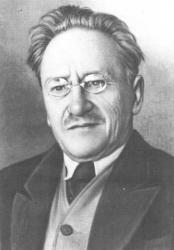
Vladimir Adamovich
- Early Life and Education
- Architectural Career
- Maturation and Early Success
- Collaboration with Vladimir Mayat
- Post-Revolutionary Period
- Architectural Legacy
- Death and Legacy
Early Life and Education
Vasily Dmitrievich Adamovichwas born into a noble family in Kaluga, Russia. He completed his secondary education at the Kaluga Gymnasium before pursuing architectural studies at the Moscow School of Painting, Sculpture, and Architecture (MUZhVZ) from 1888 to 1898.
Architectural Career
Assistant to Fyodor ShekhtelDuring his time at MUZhVZ, Adamovich worked as an assistant to the renowned architect Fyodor Shekhtel from 1893 to 1898, contributing to the design and construction of several notable mansions, including the Zinaida Morozova House, the Nikolai Kuznetsov House, and Shekhtel's own residence in Yermolaevsky Lane.
Maturation and Early Success
Upon completing his studies with a Small Silver Medal, Adamovich returned to MUZhVZ in 1900 and received a Large Silver Medal and the title of Architect for the project he submitted. He also became a technician in the Construction Department of the Moscow City Council.
Collaboration with Vladimir Mayat
In 1909, Adamovich began collaborating with architect Vladimir Mayat on numerous projects.
Post-Revolutionary Period
Teaching and ConservationFollowing the October Revolution, Adamovich dedicated himself to teaching and consulting. In 1930, he undertook the restoration of the Gu'bin House on Petrovka, originally designed by Matvei Kazakov.
Architectural Legacy
Master of Art Nouveau and NeoclassicismAdamovich is recognized as one of the prominent figures of Moscow's Art Nouveau and Neoclassical movements. Art historian Maria Nashchokina praised his works, including the Vtorov Mansion, the Konavalov Factory Buildings, and the main house of the Morozov Estate in Islavskoe, as architectural masterpieces.
Death and Legacy
Vasily Dmitrievich Adamovich passed away in Moscow in 1941. His contributions to Russian architecture continue to leave an enduring mark on the city's urban fabric.