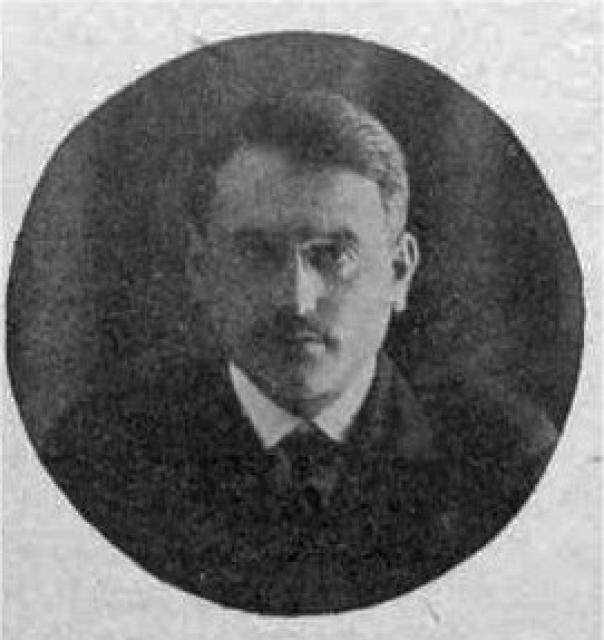
Vladimir Aitoff
 France
- Early Life and Career
- Medical Career in Russia and France
- Social and Humanitarian Work
- Wartime and Imprisonment
- Post-War Activities and Masonry
Early Life and Career
Dr. Vasily Davidovich Aitoff was born into a family of Russian Tatar descent in Kazan, Russia. His father, David Alexandrovich Aitoff, was a geographer and political emigrant who had participated in the "going to the people" movement. Vasily showed great athleticism in his youth and played rugby, winning a gold medal at the 1900 Olympic Games in Paris.
After completing his medical education at the University of Paris, Dr. Aitoff became a doctor of medicine. In 1905, he was appointed physician at the French hospital in St. Petersburg, Russia. He passed an examination at the Military Medical Academy to practice in Russia.
Medical Career in Russia and France
From 1910 to 1916, he worked at the French hospital of St. Mary Magdalene in St. Petersburg, initially as a physician and later as head of the therapeutic department. In 1916, he was attached to the French military mission and led a department of the French hospital in Petrograd.
After the Russian Revolution, Dr. Aitoff returned to France with the French military mission in 1918. He became a specialist in internal medicine and practiced in Paris. In 1920, he helped establish the organizational committee for assistance to refugees from Crimea at the Red Cross.
Social and Humanitarian Work
Dr. Aitoff was actively involved in social work. He joined the committee of the recently formed League to Combat Anti-Semitism in 1923. He also worked at the outpatient clinic of the Russian Red Cross Society and, from 1934, at the V. I. Temkin outpatient clinic, providing free medical care.
He served as treasurer of the Russian Community for Intellectual Cooperation and was a member of the Association of Russian Physicians Abroad and the board of the Mechnikov Society of Russian Physicians. He helped organize the "Russian Hospital," where renowned Russian doctors worked.
Wartime and Imprisonment
During the German occupation of France in World War II, Dr. Aitoff was deported to the Buchenwald concentration camp and later held at the Langenstein concentration camp. He eventually ended up in Auschwitz, where he was subjected to forced labor. He was liberated from the Alderstadt camp, weighing only 34 kilograms.
Post-War Activities and Masonry
After the war, Dr. Aitoff returned to Paris and became a member of the board of the Commonwealth of Russian Volunteers, Partisans, and Resistance Participants in 1946. He converted to Orthodoxy in 1946 and became a member of the parish council of the Gallipoli church in 1963. He was awarded the Order of the Legion of Honor.
Dr. Aitoff was an active Freemason, initiated into the order in 1919. He was a member-founder of the Russian lodge "Astrea No. 500" and its worshipful master from 1925 to 1926. He later became honorary worshipful master of "Astrea."
In 1926, he chaired the Provisional Committee of Russian Freemasonry, a precursor to the grand lodge in exile. He was also a member-founder of another Russian lodge, "Lotus No. 638," and served as its worshipful master, deputy worshipful master, standard bearer, and orator. He was honorary worshipful master of "Lotus" from 1957 until his death.
Dr. Vasily Davidovich Aitoff died in Paris and is buried in the Montparnasse Cemetery.


