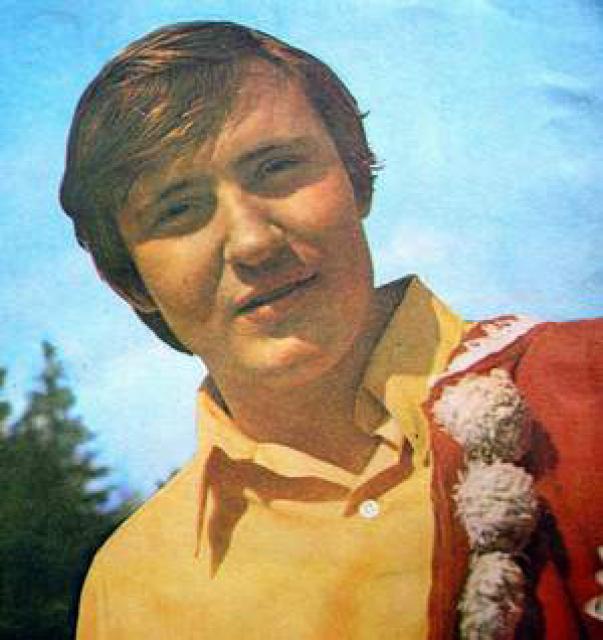
Vladimir Ivasyuk
 Ukraine
Biography of Vladimir Ivasyuk
Vladimir Ivasyuk was a Ukrainian poet, composer, and artist. He was born on March 4, 1949, in the city of Kitsman in the Chernivtsi region, into a family of teachers, Mikhail and Sofia Ivasyuk. From 1955 to 1963, he attended the local children's music school and was a student at Kitsman Secondary School from 1956 to 1966. In 1962, he participated in the final concert of the regional music school competition in Bukovina.
In 1963, Ivasyuk enrolled in the N. Lysenko Kiev Music Decade as an alto student. However, due to illness, he returned to Kitsman and continued his education at the secondary school and music school, specializing in piano. In 1964, he wrote his first song "Lullaby" based on his father's poem. He formed a vocal-instrumental ensemble called "Bukovinka" at school. In 1965, the ensemble won a trip along the Dnieper River for their victory in a republican competition.
In 1966, Ivasyuk's family moved to Chernivtsi. He enrolled in medical school but was expelled for participating in a "political incident." He started working at the Legmash factory and led the factory choir. Under the pseudonym Vesnyany, he sent his songs "The Cranes Have Flown" based on V. Mikolaychuk's poem and "Lullaby for Oksanochka" based on his own poem to the regional song competition. He won the first prize for the song "The Cranes Have Flown." From 1967 to 1972, he returned to studying at the medical institute.
In 1970, Ivasyuk wrote the songs "Chervona Ruta" and "Vodohray," which he first performed with Elena Kuznetsova on the Ukrainian television show "Kamerton of Good Mood" on September 13. In 1971, director Roman Oleksiv filmed the Ukrainian musical film "Chervona Ruta" in the town of Yaremche, starring Sofia Rotaru and Vasyl Zinkevych. The film featured many of Ivasyuk's songs. "Chervona Ruta" won the first prize at the first All-Union Song Festival "Pesnya-71." At the final concert in Ostankino, it was performed by Nazariy Yaremchuk, Vasyl Zinkevych, and Vladimir Ivasyuk accompanied by the estrada-symphonic orchestra under the direction of Yuri Silantyev. "Chervona Ruta" was published in the weekly newspaper "Ukraina."
In 1972, the song "The Ballad of Two Violins," performed by Sofia Rotaru, premiered on Chernivtsi television. The song "Vodohray" won the television contest "Allo, We Are Looking for Talents!" and the festival "Pesnya-72." Ivasyuk moved to Lviv, where he studied at the medical institute and started his education at the conservatory in the preparatory department. In November, his songs were performed by the ensemble "Smerichka" at the Lviv Theater named after Maria Zankovetska by Vladimir Ivasyuk's invitation. This marked the beginning of his collaboration with Rostislav Bratun, which was a significant stage in his career. In 1973, he graduated from the Lviv Medical Institute and entered the graduate school under the supervision of Professor T. Mitina.
In August 1974, as part of the Soviet delegation, Ivasyuk went to the International Song Contest "Sopot-74," where Sofia Rotaru won with his song "Vodohray." He also traveled through Poland with his sister Galina.
In September 1974, he started studying at the composition department of the Lviv Conservatory in the class of Anatol Kos-Anatolsky.
From 1974 to 1975, Ivasyuk worked on the music for the play "The Standard Bearers" based on O. Honchar's novel. The play was directed by Sergei Danchenko, and Ivasyuk's music received high praise from critics.
In August-September 1975, the film "The Song is Always with Us" was filmed in the village of Roztoky in Bukovina, in which Sofia Rotaru performed six of Ivasyuk's songs.
In July 1976, Ivasyuk was excluded from the conservatory for skipping classes. He wrote music for the play "Mesozoic Story" at the Drogobych Regional Music and Drama Theater.
In 1977, he resumed his studies at the Lviv Conservatory in the class of Leshek Mazepa. Sofia Rotaru won the "Sopot-77" festival with Ivasyuk's song "Spring Has Its Own Destiny." The album "Sofia Rotaru Sings Vladimir Ivasyuk's Songs" was released, as well as a collection of his songs titled "My Song."
In April 1978, he participated in the All-Union Competition of Young Composers in Yerevan. Pianist L. Desyatkin performed Ivasyuk's "Suite-Variations on the Theme of the Folk Song 'Dry Willow'" at the competition.
In October 1978, he participated in the All-Ukrainian Gathering of Young Artists in Lviv. His "Suite-Variations for Chamber Orchestra" and the premiere of the songs "Late Dahlias Summer" based on Rostislav Bratun's poem and "Our Rest, My Friend, Is Only a Dream" based on R. Kudlyk's poem were performed by the Lviv Opera soloist Igor Kushpler.
In November 1978, Ivasyuk won diplomas of the second degree at the All-Union Competition of Student Composers in Moscow for his "Suite-Variations for Chamber Orchestra" and the "Ballad about Viktor Khara."
In April 1979, he served as a jury member at the first republican competition of pop artists in Khmelnytskyi.
On the night of April 23-24, 1979, Ivasyuk left his home after a phone call and never returned. On May 18, his body was accidentally found hanged in the Brukhovychi forest near Lviv. The official version stated that it was suicide. According to unofficial versions, Ivasyuk's death was a murder committed by Ukrainian nationalists as revenge for his popularity in the USSR and his numerous performances in Moscow, including in the "official" Column Hall of the House of Unions. Residents of Western Ukraine believe that his death was a special operation planned by the KGB. Another version suggests that Ivasyuk's murder was linked to his work as an employee of the 5th department ("antisoviet agitation and propaganda") of the Lviv Regional Office of the Ukrainian KGB since 1976. However, it is also possible that his murder was related to extortion, as according to former employee of the Copyright Office Anastasia Kryvshenko, Ivasyuk was the first official millionaire, earning up to 100,000 rubles per month (approximately $70,000 based on the mid-1970s exchange rate). The details of Vladimir Ivasyuk's life and death are described in the books "Monologue in the Face of a Son" and "The Life and Death of Vladimir Ivasyuk."
In 1989, interest in Vladimir Ivasyuk's work resurged, and the "Chervona Ruta" song became the name of a festival.
On March 2, 1994, Ukrainian President Leonid Kravchuk signed a decree posthumously awarding Vladimir Ivasyuk the State Prize of Ukraine named after T. G. Shevchenko.
In 1998, a concert called "Vladimir Ivasyuk. The Return" attempted to introduce the composer's creative legacy to contemporary audiences.
On March 4, 1999, the Vladimir Ivasyuk Memorial Museum was opened in Chernivtsi.
In 2001, at the 5th Anniversary Ceremony of the All-Ukrainian Music and Entertainment Award "Golden Firebird," Vladimir Ivasyuk was awarded in the category "For Contribution to the Development of Ukrainian Music Culture of the 20th Century."
In 2003, the album "Our Ivasyuk" performed by Taras Chubay and the band "Plach Yeremiya" was released, leading to a renewed interest in Ivasyuk's work among contemporary youth.
On January 26, 2009, the General Prosecutor's Office of Ukraine reopened the long-closed criminal case on Vladimir Ivasyuk's death.


