Vsevolod Ignatovskiy
 Belarus
- Biography of Vsevolod Ignatovsky
- Education and Early Career
- Political Involvement
- Contribution to Belarusian History
- Later Years and Contributions
Biography of Vsevolod Ignatovsky
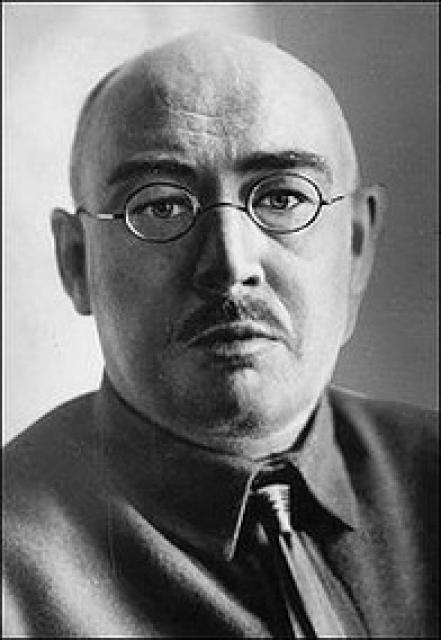
Vsevolod Ignatovsky was a Belarusian historian, public and political figure, and scholar. He was born on April 19, 1881, in the village of Tokari in the Brest district of the Grodno province (now the Kamenetsky district of the Brest region of Belarus).
Education and Early Career
Ignatovsky graduated from the Juriev (Tartu) University in 1911. From 1914 to 1921, he worked as a teacher and head of the pedagogical council at the Minsk Pedagogical Institute. In 1915, he founded the cultural and educational organization "Nash krai" in Yaroslavl, which later transformed into the organization "Molodaya Belarus" with a focus on the Belarusian Socialist Hramada (BSG).
Political Involvement
After the February Revolution, Ignatovsky organized the Council in Yaroslavl from the platform of the left-wing Socialist-Revolutionaries (Esers). He was elected to the Central Committee (CC) at the June conference of the BSG in 1917. After the split of the BSG, he joined the Central Committee of the Belarusian Socialist Party as a representative of the autonomous organization "Molodaya Belarus" in 1918. However, he did not support the Council of the Belarusian People's Republic due to dissatisfaction with its leaders' pro-German sentiments. He did not believe in the assistance of the West or the Esers' tactic of simultaneous struggle against both the Poles and the Communists.
Contribution to Belarusian History
In January 1919, Ignatovsky severed ties with the Belarusian Peasant Party-Left due to his initiative. During the Soviet-Polish War in January 1920, he created the Belarusian Communist Organization (BCO) based on "Molodaya Belarus" and participated in signing the "Declaration on the Proclamation of the Soviet Socialist Republic of Belarus" on July 31, 1920. He became a member of the All-Russian Central Executive Committee (VRK) of the Soviet Socialist Republic of Belarus from July 16, 1920. In July-August, the BCO became part of the Russian Communist Party (Bolsheviks). From December 1920, he held positions as the People's Commissar of Education in the BSSR.
Later Years and Contributions
There are unconfirmed reports that during Ignatovsky's stay in the Saratov province in the spring of 1921, he was captured by Antonov's insurgents. He refused to participate in the Soviet delegation during the signing of the Riga Peace Treaty. Ignatovsky played an important role in implementing the policy of Belarusization and actively supported the expansion of the BSSR's territory. He also contributed to the return of some Belarusian emigrants to their homeland.
In 1926, Ignatovsky became the head of the Institute of Belarusian Culture, and from 1927, he served as its first president. In December 1928, he became the president of the Academy of Sciences of the BSSR and the director of the Institute of History of the Academy of Sciences of the BSSR. However, during the campaign against so-called national-democratization in 1930, he was removed from his position as president of the Academy of Sciences of the BSSR and labeled a "kulak agent." He was summoned for questioning by the OGPU and expelled from the party. He faced criticism of his historical views and experienced persecution. On February 4, 1931, he ended his life by suicide and was buried at the military cemetery in Minsk.
Ignatovsky dedicated his research to the history of Belarus. His scientific works served as the basis for the formation of the national concept of the history of the Belarusian people, taking into account Marxist-Leninist methodology. His most complete presentation of this concept can be found in the book "A Brief Outline of the History of Belarus" (1919), which became a textbook on the history of Belarus for a long time. He also studied the history of the October Revolution and the early years of Soviet power in Belarus. Ignatovsky is credited with the idea of dividing the history of Belarus into five periods. He wrote over 40 scientific and scientific-publicist articles, including eight monographs.