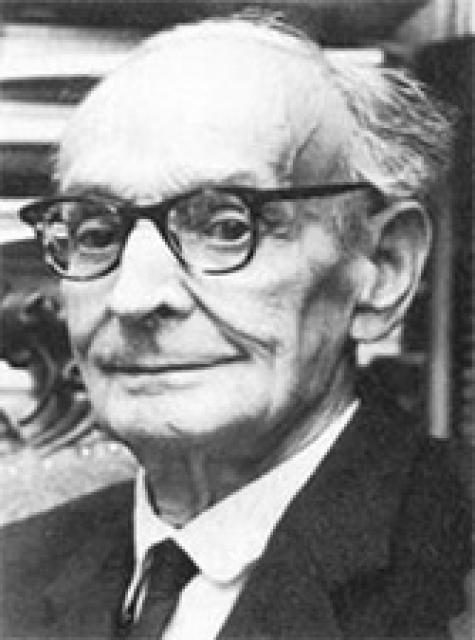
Walter Christaller
 Germany
- Early Life and Education
- Career and Central Place Theory
- Involvement in Nazi Germany
- Post-War Years and Rehabilitation
- Geography of Tourism and Legacy
- Founding DVAG
Early Life and Education
Walter Christaller was born on April 21, 1893, in Berneck, Germany. His father, Erdmann Gotrich Christaller, was an evangelical pastor and writer, while his mother, Helen Christaller, was a children's writer.
In 1913, Walter began studying philosophy and political economy at Heidelberg University but was drafted into the army in 1914. During World War I, he was injured and discharged in 1918.
Career and Central Place Theory
After the war, Christaller worked at a construction cooperative in Berlin, married in 1921, and became a construction company manager in 1925. In 1928, he lost his job and divorced. In 1929, he entered the University of Erlangen and obtained his doctorate in 1932 with a dissertation on "Central Places in Southern Germany."
Based on his dissertation, Christaller published his seminal work, "Central Places in Southern Germany," in 1933, which developed his central place theory. This theory explains the distribution of cities and towns in a hierarchy, with larger central places providing services to smaller ones.
Involvement in Nazi Germany
After Hitler's rise to power in 1933, Christaller briefly emigrated to France but returned in 1934 after receiving a grant from the German Research Society. From 1937, he worked as an associate professor at the University of Freiburg.
During World War II, Christaller joined the Nazi Party and worked in Berlin under Heinrich Himmler and Konrad Meyer-Hetling in the SS office for territorial restructuring of occupied territories. He proposed using his administrative principle for the Generalplan Ost, which aimed to settle German farmers in occupied territories.
Post-War Years and Rehabilitation
After the war, Christaller was rehabilitated and lived in West Germany. In 1951, he joined the Communist Party of Germany and became its local cell leader. He faced espionage charges, but they were later dropped.
Geography of Tourism and Legacy
In the 1950s, Christaller shifted his focus to geography of tourism. He published numerous articles, monographs, and guidebooks on the subject.
Christaller's ideas had a significant impact on economic geography, particularly in the United Kingdom and the United States. His central place theory has influenced urban planning and regional development.
Founding DVAG
In 1950, Christaller co-founded the German Association of Applied Geography (DVAG) with Paul Gauss and Emil Meynen. He remained an active member until his death on February 6, 1969.




