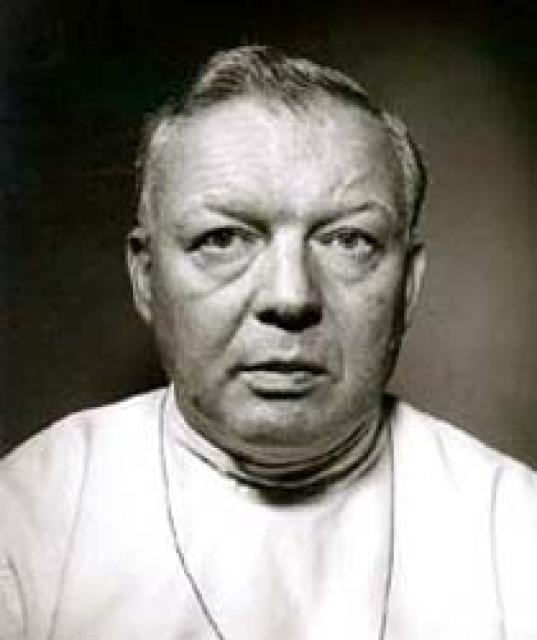
Werner Forssmann
 Germany
Biography of Werner Forssmann
Werner Theodor Otto Forssmann, a German physician, was born in Berlin to Julius Forssmann and Emmi (Gindenberg) Forssmann. He received his primary education at the Askanian Gymnasium in Berlin.
In 1916, when Forssmann was 12 years old, his father, a captain in the German army, died in the Galician Battle. In 1922, Forssmann became a student at the Medical Faculty of the University of Berlin. Due to the economic situation in the country after the war, Forssmann had to take temporary work at a bank to support himself. Nevertheless, he passed the preliminary medical exams and, after two years of internship, obtained his medical degree in 1928.
In 1929, Forssmann began working at the Eberswalde Surgical Clinic near Berlin, where he started a series of experiments to demonstrate the anatomical and functional features of the human heart during its diseases using catheterization. This method involves introducing a catheter into the heart through a vein. Before Forssmann's experiments in this field, very little had been done. In 1861, two French physiologists performed heart catheterization on experimental animals. Later, in 1912, German doctors attempted to introduce a catheter into the abdominal aorta of women suffering from puerperal sepsis (complications of postpartum infection) to improve drug therapy. The women did not experience any harmful effects from this procedure. In 1928, an Italian researcher introduced a catheter into the heart of experimental animals and human cadavers. In 1929, after conducting similar experiments on cadavers with catheter insertion into the right chambers of the heart, Forssmann set out to prove the safety of this method in clinical practice. He persuaded one of his colleagues at the Eberswalde Surgical Clinic to help him experimentally perform this procedure on himself. The colleague succeeded in introducing a catheter (a tube about 65 cm long and 1 mm in diameter) into Forssmann's elbow vein. Starting to advance the catheter towards the heart, he became afraid that it might be too dangerous and stopped the experiment. A week later, without obtaining permission or even informing his supervisor, Forssmann independently performed heart catheterization on himself. In the presence of only a nurse, Forssmann administered local anesthesia, made an incision, exposed the vein, inserted the catheter, and advanced it approximately 60 centimeters until it entered the right atrium. In the X-ray department, with the help of the nurse holding a mirror, Forssmann, looking at the X-ray machine screen, confirmed that the catheter's tip had reached the heart. He subsequently conducted several similar experiments, bringing their total number to nine. In two cases, he introduced contrast agents into the blood, allowing him to obtain much more detailed X-ray images of the heart than with conventional radiography. After completing this series of experiments, Forssmann published the article "Probing the Right Heart," in which he described the catheterization technique and discussed its potential for studying the anatomical and functional characteristics of the cardiovascular system in normal conditions and during its diseases. Trying to improve his method, Forssmann began a series of experiments using laboratory animals, but the lack of resources at the clinic forced him to stop the experiments.
Forssmann presented the results of his research at the 25th Conference of the German Surgical Society in April 1931. However, the authorities of German medicine did not pay attention to the importance of his experiments. A year later, he was hired by Ferdinand Sauerbruch at a hospital for the poor in Berlin. However, when one of the Berlin newspapers published a sensational report about his experiments at the Eberswalde Clinic, Forssmann faced a barrage of criticism from his colleagues. Sauerbruch even called him a charlatan and fired him. Forssmann was so insulted by what had happened that he decided to discontinue his research.
Meanwhile, in the United States, Andre Cournand and Dickinson W. Richards from the College of Physicians and Surgeons at Columbia University learned about Forssmann's experiments at the Eberswalde Clinic. Their position turned out to be directly opposite to that of the German doctors. Embarking on an extensive research program in the 1930s, they eventually achieved the goals initially set by Forssmann. In 1941, Cournand performed the first successful heart catheterization in the United States. In the late 1940s and early 1950s, Forssmann's developed heart catheterization technique with subsequent radiographic examination became common diagnostic and research practices.
Interrupting his research on the cardiovascular system, Forssmann began specializing in urological surgery in 1932 under the guidance of Karl Hoisch at the Rudolf Virchow Hospital. A year later, he married urologist Elsbeth Engel, and the couple had six children. Later, Forssmann became the head of the surgical clinic at the Friedrichstadt Hospital in Dresden and the Robert Koch Hospital in Berlin, where he practiced surgery and urology until the start of World War II. During the war, Forssmann served as a doctor in the Wehrmacht, operating on the wounded, and obtained the rank of Major in the Medical Service. In early 1945, when Germany's defeat became evident, Forssmann surrendered to the Americans. After being released at the end of the war, he worked for a while in a lumberyard in the Black Forest and then resumed surgical practice with his wife. In 1950, the Forssmanns moved to the small town of Bad Krozingen on the Rhine, where Forssmann referred to his work there as "the slave labor of an insurance doctor." In 1954, he published an article on the history of the development of heart catheterization, focusing on lung diseases.
In 1952, Forssmann, Cournand, and Richards were awarded the Nobel Prize in Physiology or Medicine "for discoveries concerning heart catheterization and pathological changes in the circulatory system." In his Nobel lecture, "The Role of Heart Catheterization and Angiocardiography in the Development of Modern Medicine," Forssmann briefly listed the major achievements of cardiology since the Renaissance. He also raised the issue of the potential dangers of heart catheterization and insisted that its use be limited only to patients who need it for diagnosis. Two years after receiving the Nobel Prize, Forssmann was appointed head of the surgical department at the Evangelical Hospital in Düsseldorf. From 1962 until his death, he remained a member of the executive committee of the German Surgical Society. He retired from surgical practice in 1970. Forssmann died on June 1, 1979, at a resort in the Black Forest after suffering a heart attack.
Forssmann was awarded the Leibniz Medal by the German Academy of Sciences (1954) and the Gold Medal of the Society of Surgical Medicine in Ferrara, Italy (1968). He was a member of the American College of Chest Physicians, the German Urological Society, and the German Association of Pediatric Healthcare. He was also elected an honorary member of the Swedish Society of Cardiology.


