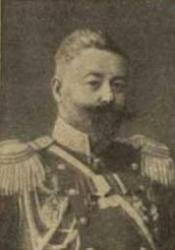
Werner von Fritsch
 Germany
Biography of Werner von Fritsch
Werner von Fritsch was a general-field marshal of the Wehrmacht and the first German general to die in World War II. He was born in Benrath in the Rhine Province of the German Empire. After finishing school, Von Fritsch joined the army in September 1898 as a Fahnenjunker in the 25th Prussian Field Artillery Regiment, and two years later, he was promoted to lieutenant. His outstanding abilities were duly recognized by his superiors. In 1907, he entered the Prussian Military Academy in Berlin and graduated in 1910. He was promoted to Oberleutnant and enrolled in the General Staff in 1911. In 1913, Von Fritsch was promoted to captain. Baron Von Fritsch participated in World War I and distinguished himself in battle on numerous occasions. He was often decorated, including receiving the Iron Cross First Class and the Wound Badge for a head injury. He ended the war with the rank of major, which he received in 1917. After the war, he remained in the Reichswehr. Initially, Baron worked at the Ministry of Defense, and later, he was appointed as division commander in the 5th Artillery Regiment. On February 5, 1923, he was promoted to lieutenant colonel. On April 1, 1924, Von Fritsch was appointed Chief of Staff of the 1st Infantry Division. In 1926, he became the head of the Army Department in the Army Command (Truppenamt) and on March 1, 1927, he was promoted to colonel. In 1928, he became the commander of the 2nd Artillery Regiment, and on November 1, 1930, he was promoted to major general. In 1931, he became the commander of the 1st Cavalry Division, and then, in 1932, the commander of the 3rd Infantry Division and the III Military District. In the same year, Fritsch was promoted to lieutenant general.

Role in Nazi Germany
After the Nazis came to power, Von Fritsch was appointed head of the High Command of the Army and later the Commander-in-Chief of the Army. From 1934 to 1938, as Commander-in-Chief of the Army, he actively contributed to the rearmament of Germany, working with his comrades in the Reichswehr to rebuild the army. Like many old officers, he had a conservative and anti-Nazi mindset. Having experienced war in his lifetime, he was hostile to Hitler's aggressive plans. During the Hossbach Conference on November 5, 1937, he opposed the political leadership's preparations for war.
On April 20, 1936, Von Fritsch was promoted to general field marshal. In 1938, he was forced to resign due to allegations of homosexuality. In 1935, a petty extortionist named Otto Schmidt was arrested. He provided incriminating testimony that his victims were mostly homosexuals, including General Fritsch. As the case took a political turn, it was handed over to criminal investigator Josef Meisinger, who aimed to prove that the Chief of the Army High Command, Baron Werner von Fritsch, was Schmidt's victim. During a photo identification procedure, Schmidt "correctly" identified a photo labeled "General Field Marshal Baron Fritsch, Chief of the Army High Command." He then provided detailed testimony about the incident. Meisinger reported the investigation results to the leadership, and soon afterward, Himmler presented a transcript of Schmidt's interrogation to Hitler. Hitler ordered it to be burned. At that moment, he still needed Von Fritsch as a military expert. Himmler had to carry out Hitler's order. However, before destroying the case materials, Heydrich made copies of the most important documents. It should be noted that the slander found support in the fact that Fritsch did not socialize with women, showing interest only in his service, and he was never married. However, after a meeting in the Reich Chancellery on November 5, 1937, Hitler's attitude changed sharply because Von Fritsch and Von Blomberg expressed their skepticism about Hitler's expansionist plans and had a dispute with Göring. Göring decided to get rid of them. Von Blomberg was quickly removed from office when compromising photos of his wife, Erna Gruhn, were found in the Gestapo archives. Göring informed Hitler about this on January 24, 1938, mentioning Von Fritsch as well. According to Meisinger, it was Göring who ordered him to reopen the criminal case against Von Fritsch, which was immediately presented to Hitler. Hitler was shocked. Although Von Fritsch denied everything, he did nothing to defend himself. But his friends in court proved that the real victim of Schmidt was a namesake of the general in the rank of Rittmeister, and Himmler and Heydrich knew about it but did nothing. Presiding Judge Göring had to acknowledge Von Fritsch's innocence. On March 18, 1938, Von Fritsch was acquitted and reinstated in the army. After the dismissal of the charges, General Baron Von Fritsch was reinstated in the army. In 1939, he became the honorary chief of the 12th Artillery Regiment, which was part of the 12th Infantry Division. He fought against the Polish army during the September Campaign in Poland. Generals Keitel and Von Brauchitsch recommended Von Fritsch to be appointed as the commander of the troops in East Prussia or one of the army groups, but Hitler refused, citing that he was not yet ready to give troops to Von Blomberg. On September 22, Von Fritsch died near Warsaw. According to General Manstein, Von Fritsch, unable to accept the Nazi regime, sought death in battle and impeded the dressing of his wounds. General Keitel, on the other hand, believed that Von Fritsch's death was a tragic accident. The general was struck by a stray bullet during a conversation with the staff officers of the division and died a few minutes later. Lieutenant Rosenhagen, his adjutant, wrote in the death protocol: "At that moment, General was shot in the left thigh, the bullet severing an artery. He fell immediately. Before I removed his suspenders, the General said, 'Leave me,' lost consciousness, and died. Only one minute passed between the injury and death." He became the first German general to die in World War II and the only one to die during the September Campaign in Poland. Four days later, he was buried in the Invalids' Cemetery in Berlin. The words "Be faithful unto death, and I will give you the crown of life" (Rev. 2:10) are inscribed on his gravestone.
A monument was erected at the site of the general's death, but it was dismantled after the end of World War II. In honor of Fritsch, barracks were named after him in Pfullendorf, Celle, Brandenburg, Koblenz, Darmstadt, and Hannover-Botfeld. The 177th Self-Propelled Artillery Battalion of the Bundeswehr has the letter "F" (in his honor) on its vehicles. Von Fritsch was awarded numerous medals and decorations, including the Iron Cross Second and First Class, the Knight's Cross of the Royal House Order of Hohenzollern with swords (Prussia), the Order of the Red Eagle Fourth Class (Prussia), the Prussian Cross for Military Merit, the Bavarian Order of Military Merit Fourth Class with swords and a crown, the Knight's Cross First Class with swords of the Friedrich Order (Württemberg), the Knight's Cross of the Order of Merit II Class of the Grand Duchy of Hesse, the Hamburg Hanseatic Cross, the Wound Badge in Black, the Cross for Military Merit Third Class (Austria-Hungary), the Gallipoli Star Medal (Ottoman Empire), the Maltese Order of Chivalry and Justice, and medals for military distinctions from the fourth to the first class. He was also awarded the Order "Pour le Mérite" (April 1, 1918) (Prussia).