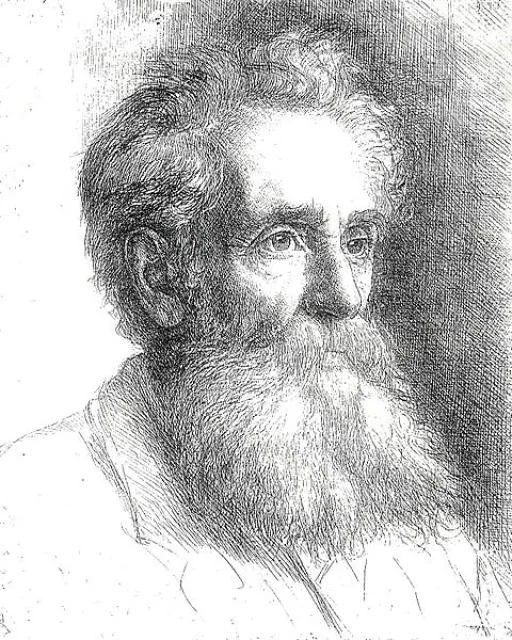
Wilhelm Jerusalem
 Austria
- From a Bohemian schoolroom to philosophy
- Education and the psychology of learning
- Pragmatism and the social roots of knowledge
- Recognition in Vienna
Wilhelm Jerusalem was an Austrian philosopher, educator, psychologist, and sociologist whose work linked questions of knowledge to language, education, and social life. A longtime secondary-school teacher before becoming a university lecturer, he argued for a more prominent place for sociology in academic study and explored the social origins of thought. He was born in Dřenice, Bohemia, on October 11, 1854, and died in Vienna on July 15, 1923.
From a Bohemian schoolroom to philosophy
Jerusalem grew up in a Jewish family in Bohemia and studied at the University of Prague, where he trained in classical philology. He began his career as a teacher, working in Prague and Nikolsburg before settling into school teaching in Vienna. Teaching gave him a sustained interest in how people learn, how language develops, and how education can shape the growth of the mind.
His work gradually moved beyond the classical subjects he had first taught. He took on instruction in philosophical propaedeutics, or introductory philosophy, and began writing textbooks and essays for students and teachers. His Lehrbuch der Psychologie and Einleitung in die Philosophie (Introduction to Philosophy) were widely used, with the latter going through multiple editions and reaching readers beyond the German-speaking world.
Education and the psychology of learning
Jerusalem treated education as an intellectual and social undertaking, not simply the delivery of information. In Unsere Mittelschule (Our Secondary School, 1907) and Die Aufgaben des Lehrers an höheren Schulen (The Tasks of Teachers in Higher Schools, 1912), he addressed the purpose of secondary education and the professional responsibilities of teachers. His writing spoke to the changing role of schools in a society increasingly shaped by scientific knowledge and public debate.
He also took an interest in the education of people with combined hearing and vision disabilities. His study of the American educator Laura Bridgman examined how language and learning could develop through tactile communication. That interest reflected his wider concern with the relationship between thought and expression: language, in his view, was central to how people organize experience and participate in a shared world.
Pragmatism and the social roots of knowledge
Jerusalem became one of the early European interpreters of American pragmatism. He translated William James’s Pragmatism into German and engaged with the idea that concepts should be understood through their practical consequences. He combined this outlook with an interest in empirical psychology and the philosophical debates of his time.
His most original contribution was to argue that knowledge is shaped by social life. In work that anticipated later sociology of knowledge, Jerusalem examined how language, shared practices, and collective experience influence what people regard as meaningful or true. Rather than treating ideas as products of isolated minds, he emphasized the social conditions in which thinking takes place. He advocated establishing sociology as an academic discipline and contributed to its early theoretical development.
Recognition in Vienna
Jerusalem’s academic career advanced slowly while he continued teaching in schools. He became a lecturer at the University of Vienna in 1891, but only in 1920, after decades of university teaching and scholarship, was he appointed associate professor of philosophy and educational theory. He also taught at Vienna’s Jewish Theological Institute from 1894 to 1902.
He died in Vienna in 1923, aged 68. His career connected the classroom to philosophy and the emerging social sciences: he wrote for teachers and students, investigated the psychology of learning, introduced German readers to pragmatism, and helped formulate an early sociology of knowledge.