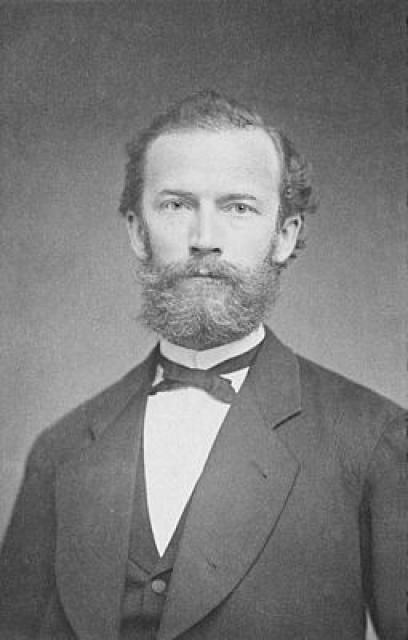
Wilhelm Kohlrausch
 Germany
- Life and Career
- Early Life and Education
- Early Career in Physics
- Focus on Electrical Engineering
- Director of the Physical Technical Institute
- Scientific Contributions
- Physical Chemistry and Electrolytes
- Legacy
Life and Career
Wilhelm Kohlrausch was a German physicist and electrical engineer who made significant contributions to the fields of electricity, magnetism, and optics.
Early Life and Education
Kohlrausch was born in Rinteln, Germany, in 1844. He studied physics at the University of Göttingen and received his doctorate in 1867.
Early Career in Physics
From 1878 to 1883, Kohlrausch served as an assistant to Professor August Kundt in Strasbourg. During this time, he published several theoretical works on optics, acoustics, and magnetism.
Focus on Electrical Engineering
In 1884, Kohlrausch's research interests shifted to the technical applications of electricity. He became the first professor of electrical engineering at the Technical School in Hannover and served as its rector from 1892 onwards.
Director of the Physical Technical Institute
Following the death of Hermann von Helmholtz in 1894, Kohlrausch was appointed director of the Physical Technical Institute in Berlin, a position he held from 1895 to 1905.
Scientific Contributions
Kohlrausch's scientific work focused on the areas of electricity, magnetism, and optics. He developed methods for measuring electrical current in absolute units and electrical resistance in electrolytes (Kohlrausch bridge). He also invented instruments for recording changes in the Earth's magnetic field.
Physical Chemistry and Electrolytes
In the field of physical chemistry, Kohlrausch conducted extensive research on electrolyte solutions. He developed a method for determining the electrical resistance of electrolytes and established the law of independent ion movement in electrolytes (Kohlrausch's law).
Legacy
Wilhelm Kohlrausch's contributions to physics, particularly in the areas of electrical engineering and electrochemistry, have had a lasting impact on the field. His methods and instruments are still widely used today, and his discoveries have laid the foundation for future research in these disciplines.


