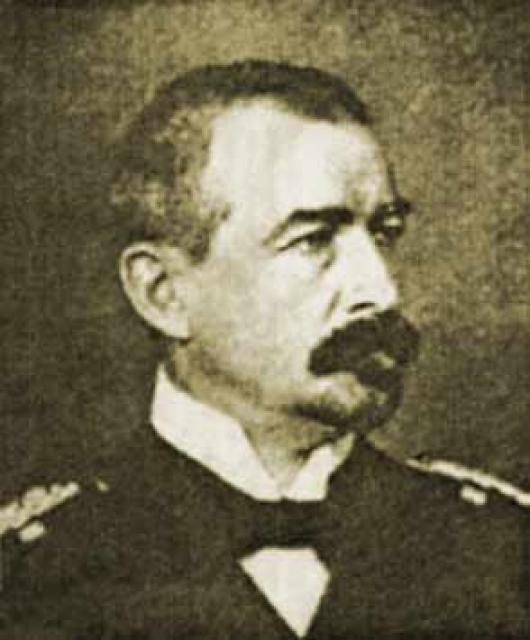
Wilhelm Sushon
 Germany
Biography of Wilhelm Souchon
Wilhelm Souchon (1864-1946) was a German Rear Admiral during World War I. Despite having only two ships at his disposal, Rear Admiral Souchon played a significant role in the war. He successfully persuaded Turkey to join the war on the side of Germany and effectively fought against the numerically superior fleets of the Entente powers in the Black and Mediterranean Seas.
Souchon was born on June 2, 1864, in Leipzig. At the age of 17, he became an officer and soon commanded the gunboat "Adler," participating in Germany's capture of the Samoan Islands. Throughout his career, Souchon held various command and staff positions, including commanding the battleship "Wettin" and serving as the chief of staff of the German Baltic Fleet. In 1911, he was promoted to the rank of Rear Admiral.
Souchon's path to history began a year before the outbreak of World War I. On November 1, 1912, as per the initiative of Alfred von Tirpitz, the Kaiser issued an order to form the Mediterranean Division consisting of the latest cruisers - the battleship "Geben" and the light cruiser "Breslau". The firepower of this division exceeded that of any British ship in the Mediterranean. On October 23, 1913, Rear Admiral Wilhelm Souchon took command of the division. He took decisive measures to repair the battleship "Geben." By the end of July 1914, the battleship was stationed in Pola, while the "Breslau" was in Durazzo. In March, Souchon, together with Austrian Admiral Gauser, determined the main task of the Austro-German-Italian forces - to prevent the transfer of the Algerian Corps to France. To accomplish this task, the "Geben" and "Breslau" met with Italian cruisers and destroyers in Brindisi. On August 2, news of the war with Russia and the impending war with France reached Souchon. Without receiving orders from the Naval General Staff, Souchon refueled in Messina and headed towards Bone and Philippeville for shelling. Before leaving, he ordered the ships to be prepared for sinking, just in case. Upon receiving the news of the war with France on the morning of August 4, Souchon bombarded the ports chosen for loading colonial troops. As a result, their arrival in France was delayed by three days, which was crucial during the decisive German offensive. On the same day, Rear Admiral Souchon received orders to sail to Constantinople.
The English Admiral Berkeley Milne had instructions not to lose sight of the German ships, as they gained special importance in the communications in case of war. On August 4, a few hours before the declaration of war by Great Britain, the battle cruisers "Indefatigable" and "Indomitable" encountered the "Geben" and sailed alongside them for a long time, but the British did not open fire until the start of hostilities, and then lost sight of the enemy in the darkness. The next day, the British squadron headed for Gibraltar, expecting the German ships to break through into the expanses of the Atlantic. However, Souchon chose a different path. He sailed towards the Dardanelles, warding off English cruisers, and entered the strait. The Anglo-French fleet blockaded the Dardanelles after Souchon's departure: the Allies protected their troop transports from German ship raids. The Allies expected that neutral Turkey would demand the disarmament of the German squadron, but in vain. Since December 1913, a German military mission led by Liman von Sanders had been operating in the capital of Turkey, gradually gaining control over the Turkish armed forces. With Souchon's arrival, the fleet also fell under his control. On August 10, the squadron arrived in Istanbul, where mobilization had been underway since August 3, finishing on August 22. At Souchon's request, the ships were "purchased" by Turkey on August 12, entered its fleet, and received new names: "Yavuz Sultan Selim" and "Midilli." The English admiral who commanded the Turkish fleet ordered the removal of British officers and sailors from the Turkish ships. The imperial decree appointed Souchon as the commander of the Turkish fleet, and the next day, the renamed German ships raised Turkish flags, entered the port of Istanbul, and docked at the Moda pier. On August 16, they participated in the maneuvers of the Turkish fleet. The inclusion of the German ships in the fleet was declared by the Sultan's government as a replacement for the two dreadnoughts that were being built in England for Turkey. Both of them were confiscated by the British government, although there was no war with Turkey at that time. By that time, the Turkish Minister of War, Enver Pasha, proposed an offensive on Egypt to capture the Suez Canal. Liman von Sanders, the head of the German mission, developed adventurous plans, including landing a landing force near Odessa, which was supposed to advance in support of the retreating Austrian forces. Souchon objected, as the German-Turkish forces on the Black Sea did not have either superior forces or enough transports. Enver Pasha recommended Souchon to withdraw the squadron to destroy the Black Sea fleet. Eventually, a decision was made to strike the coast of Russia with the main German-Turkish forces.
Souchon stated that he did not consider himself bound by the decisions of the Porte due to the fictitious inclusion of his ships in the Turkish fleet, and the German ambassador declared: "German ships are only to a certain extent subordinate to the Turks and are intended to serve not only Turkish but primarily German interests." In late September, with the Kaiser's permission, Souchon transferred to Turkish service with the rank of Vice Admiral. "Pasha Souchon" was appointed as the de facto head of the Turkish fleet to reorganize it. From September 21, German ships began to go to the Black Sea daily under the escort of Turkish ships to accustom the population to their presence. At Souchon's request, two groups of naval officers were sent from Germany through neutral countries. Before the war began, materials for ship repairs and mine barriers were delivered from Germany. In August and September, German specialists fortified the Bosporus and the Dardanelles.
During this period, German diplomacy threatened Romania with the bombardment of Constanta by Souchon's ships if it joined the Entente. Turkey closed the Dardanelles, cutting off communication between Russia and its allies in the Entente. The fortification of the Dardanelles ensured the rear of the German-Turkish forces in case of hostilities in the Black Sea. The defense of Turkey's coast was organized by a German admiral, Uzedom, who arrived in late August with a mission of 500 German sailors. He was appointed the inspector general of coastal artillery and mine warfare. Based on his proposal, the Dardanelles were closed. The pretext was the delay of a Turkish destroyer leaving the straits, which was stopped by an English cruiser on September 27. On October 22, Enver Pasha sent a plan of military operations to the German high command, which included a first step of attacking the Russian coast before declaring war. Souchon was given the time to start the operation. On October 25, he received an order from the Minister of Naval Affairs, stating: "The admiral acts on the highest command of the Sultan, and the fleet must obey him."
To involve Turkey in the war and weaken the Russian Black Sea Fleet, Souchon launched a major attack with the Turkish-German forces on the Russian coast, with Turkish crews reinforced by German sailors. According to his plan, the battleship "Geben" with two destroyers was to shell Sevastopol, and the mine barrier was to lay mines in front of the main base. The "Breslau" was to lay a mine barrier in front of the Kerch Strait and then, together with the minelayer "Berk," shell Novorossiysk. The cruiser "Hamidiye" was to shell Feodosia, and the destroyers "Gayret" and "Muavenet" were to attack ships in Odessa, while the minelayer "Samsun" was to lay mines on the approaches to Odessa or Ochakov. On October 29, 1914, the German-Turkish forces attacked the port of Odessa, Sevastopol, and laid mine barriers near Odessa, Sevastopol, and in the Kerch Strait. They shelled Fidonisi and Novorossiysk, destroyed several ships, and escaped with almost no damage. Despite warnings from diplomats, the Black Sea Fleet was not prepared for the attack.
Upon the squadron's return to Istanbul, false information was spread that Turkish actions were a response to Russian attempts to mine the Bosporus. The text was prepared in Souchon's headquarters.
From 1914 to 1917, Souchon commanded the German, Turkish, and Bulgarian naval forces. He carried out raids on Russian ports, organized cruiser warfare against Russian merchant shipping, and inspired the Turks to war through the display of German flags along the Anatolian coast, while also supporting the flank of the army.
The Russian fleet, until the entry of the first dreadnought "Imperatritsa Maria," capable of fighting on an equal footing with the "Geben," primarily conducted mine warfare, initially defensive. From November 6 to December 11, 1914, two Russian mine barriers were laid with 1,668 mines in the Odessa-Ochakov area. However, active operations soon began. On November 6, 1914, destroyer flotillas laid 240 mines in front of the Bosporus. On the same day, Russian ships shelled Zonguldak, from which Constantinople received coal, and on the return trip seized three Turkish transports. Thus began the traditional actions of blockading the Turkish capital and cutting off fuel supplies from the coal region of Turkey.
From November 15 to 18, the Black Sea Fleet, consisting of five battleships, three cruisers, and thirteen destroyers, cruised along the Anatolian coast and, on November 16, bombarded Trabzon and surveyed the waters off the coast. After the shelling, Russian sailors laid 400 mines at Trabzon and other ports. Souchon could not ignore this and took his fleet to sea. On November 18, the Russian fleet encountered the German-Turkish forces of the battleship "Geben" and the cruiser "Breslau" in a battle at Cape Sarych on their way back to Sevastopol. The Russian fleet inflicted damage on the "Geben," which required two weeks of repairs.
From December 20 to 25, 1914, the Black Sea Fleet sailed towards the Bosporus. Two battleships bombarded the fortifications on the strait on December 28, while planes from the aviatransport "Nikolai I" conducted reconnaissance and bombing. On December 29, the fleet waited for an enemy near the strait, but the German-Turkish ships did not appear. On December 30, the Russian ships shelled Eregli, Zonguldak, Kozlu, and Kilimli.
The German-Turkish forces retaliated. From April 1 to 3, 1915, the Turks attempted to shell Odessa, but the cruiser "Medjidie" struck a mine on the approach to the port, was sunk, and the operation was abandoned. On April 3, the Russian fleet sailed from Sevastopol when the "Geben" and "Breslau" appeared near the base, but the battle was limited to long-range fire. The German-Turkish ships escaped pursuit, taking advantage of their superior speed.
The Black Sea Fleet went on blockade duty at the Bosporus in May and destroyed ships carrying coal. On May 10, Russian ships bombarded the Bosporus fortifications and engaged in battle with the "Geben" - several hits put it out of action. On June 11, in a nocturnal battle near the Bosporus, the destroyers "Derzkiy" and "Gnevny" damaged the cruiser "Breslau." On July 10, the underwater minelayer "Krab" successfully laid a mine barrier at the mouth of the Bosporus on its first combat mission. On July 18, the minelayer was blown up and put out of action for 7 months, and on January 2, 1915, the minelayer "Breslau" was also damaged and did not return to service until the end of the war. From 1916, the danger from mines became so great that Souchon had to organize regular mine sweeping operations to support the fleet's sorties.
In 1915, Souchon requested large submarines from Germany, not small ones, capable of operating in the Dardanelles against the Allied fleet. In total, 12 submarines sank 19 steamers and about 30 sailing ships during the war, unsuccessfully attacking warships. Secret anchorages were organized along the Turkish coast for their basing. Varna served as a base on the Black Sea. On October 27, the ships of the Black Sea Fleet bombarded Varna, where German submarines were based after Bulgaria joined Germany. Before the bombardment, aircraft from the aviatransport "Nikolai I" conducted reconnaissance and bombing of the port. However, despite the air raids, the submarines continued to operate.
In September 1917, Souchon was transferred to command the 4th Squadron of the High Seas Fleet, with which he participated in the capture of the Gulf of Riga and the Moonzund Islands. On April 12, he entered Helsinki.
Admiral Souchon retired in March 1919. He quietly lived in the provinces, occasionally visiting Berlin to commemorate some anniversary of the naval events of the war. In 1938, he was ceremoniously welcomed in Istanbul with honors befitting a head of state. Souchon passed away on January 13, 1946, in Bremen. He lived to witness the rebirth of the German fleet and its second demise in World War II.


