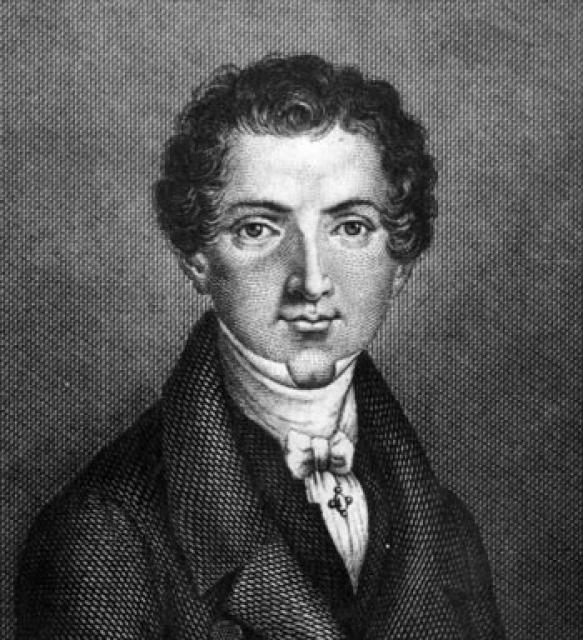
Wiligelm Gauf
 Germany
Biography of Wilhelm Hauff
Wilhelm Hauff was a German writer and storyteller born on November 29, 1802. His "Almanac of Fairy Tales for 1826" immediately earned him a prominent place in German literature. He emerged as a romanticist of the younger school and a student of Hoffmann. While he was not as powerful or profound in imagination as his teacher, Hauff far surpassed him in the clarity of his images and thoughts, the completeness of his forms, and the elegance of his language.
In his fairy tales, Hauff showcased a wealth of good-natured, cheerful humor that was equally enchanting for both children and adults. He had a remarkable ability to transform the most hackneyed plots of eastern tales, such as "Little Mook," which had been circulating in Europe for centuries, into entertaining stories full of everyday and psychological truth. His "Almanac," published under the name "Tales of Hauff," was reprinted countless times. In the same year, 1826, he published his novel "Lichtenstein," one of Germany's finest historical novels.
In 1827, Hauff released his work "Memoirs of Satan," in which he successfully and independently absorbed Hoffmann's fragmentary style. That same year, he published a small book that is still avidly read today: "Phantasies in the Bremen City Hall Cellar," in which his joyous imagination is expressed with full force. He also published several well-conceived novellas, with the best of them being considered "The Beggar Woman of the Font des Arts" in "The Emperor's Image."
Germany had hoped to have one of its best fiction writers and poets in Hauff (some of his lyrical plays became folk songs soon after their release), but he died before reaching the age of 25.