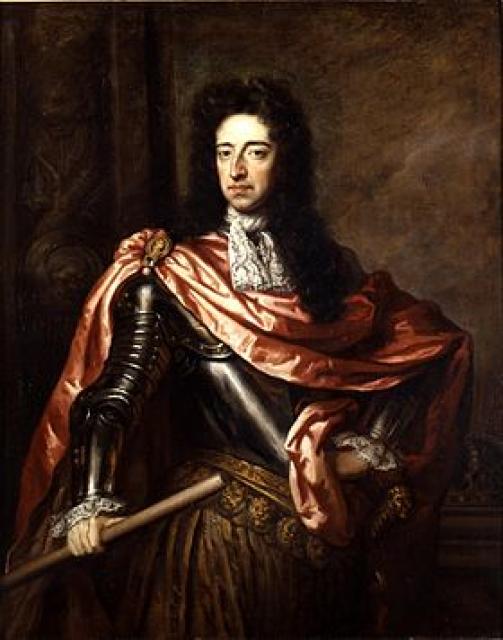
Willem III, prins van Oranje
 Netherlands
Biography of William III of Orange
William III of Orange was the King of England and Scotland from 1689 to 1702. He was a frail and sickly man with a high forehead and a nose that resembled an eagle's beak. Despite his physical weaknesses, he possessed strong passions and a lively sensitivity, which he concealed behind a calm and phlegmatic demeanor.
Born into the illustrious and famous House of Orange in the Dutch Republic, William became an orphan at a young age. His father, William II, died a week before his birth. After the death of the elder statesman, the party of the States General took control of the country for the next 22 years, suppressing the Orangists who sought to establish a monarchy in favor of the Orange dynasty. During this time, the highest position of Stadtholder was abolished. In 1670, William was admitted to the State Council with the right to vote, marking the beginning of his political career.
William was a slender and physically weak man who suffered from various ailments such as shortness of breath and a predisposition to consumption. However, he possessed strong qualities of a great ruler and dedicated his entire life to politics. He had a sharp and sarcastic wit, which made his speeches powerful and memorable. He was multilingual, speaking Latin, Italian, Spanish, French, English, and German fluently.
Surrounded by spies and enemies from an early age, William learned to be cautious, secretive, and impenetrable. Only in the company of a few close friends could he shed his cold facade and reveal his true warmth and humor. He had little interest in sciences, arts, or literature, and his upbringing as a strict Calvinist made him intolerant of other religions.
In 1672, a war with France began, and the Dutch Republic suffered heavy defeats. The General States initially appointed William as Captain-General, but due to further French invasions, he was proclaimed Stadtholder in July of that year. The uprising of the people led to the deaths of Jan de Witt and his brother in The Hague. William seized control of the country, and soon the Dutch turned the tide of the war, pushing the French back and gaining victories.
In 1688, William received a formal invitation from leaders in England to claim the English throne. He prepared for the campaign and wrote a manifesto, pledging to defend English laws and religious freedom. He embarked on a voyage to England in November, and upon his arrival, he was greeted with joy by the people. King James II fled, and William and his wife Mary were jointly crowned as the rulers of England.
Throughout his reign, William faced challenges from Jacobites who supported the deposed King James II and opponents of his policies. He successfully suppressed uprisings in Ireland and Scotland, cementing his position as the ruler of all three parts of the kingdom.
William's reign was marked by his continuous struggle against France and his efforts to maintain a balance of power in Europe. He secured peace treaties and alliances with other European powers, with the aim of containing French expansionism. Despite facing opposition from the English Parliament, William's determination and hatred towards the French drove his policies.
In 1702, William III died after a fall from his horse. His projects and his deep animosity towards France were carried on by his successors, shaping the course of European politics in the following years.