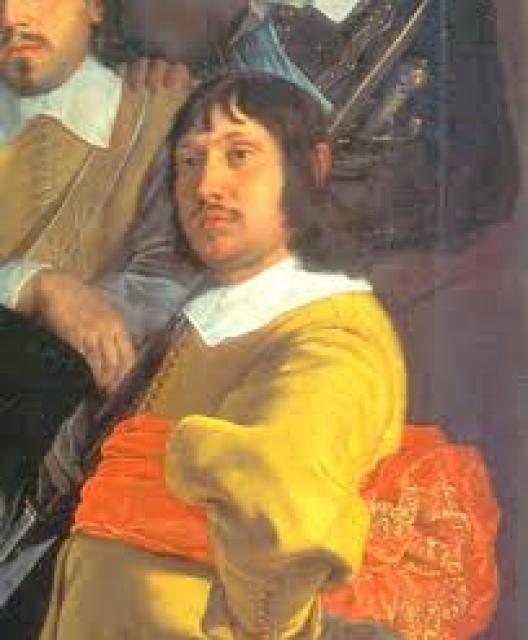
William Baillie
 Great Britain
- William Baillie: Scottish Covenanter and Military Leader
- Service in the Swedish and Scottish Armies
- Role in the English Civil War
- Return to Scotland and Conflict with Montrose
- Defeat at the Hands of Montrose
- Resignation and Reinstatement
- Defeat at Kilsyth
- Later Career
William Baillie: Scottish Covenanter and Military Leader
William Baillie, a Scottish military commander and Covenanter, played a significant role in the Scottish Civil War (1644-1646).
Service in the Swedish and Scottish Armies
In the 1630s, Baillie served as a captain in a mercenary unit of Scottish soldiers fighting in the Thirty Years' War under King Gustavus II Adolf of Sweden. Upon returning to Scotland in 1639, he joined the Covenanter movement, a religious and political alliance opposing the policies of King Charles I.
Role in the English Civil War
Baillie's military experience was instrumental in the service of the Scottish Parliament during the English Civil War. Following the formation of the Solemn League and Covenant between Scotland and England in 1643, General Baillie became one of the commanders of the Scottish army led by the Earl of Leven, which was sent to England to assist the Parliament against the Royalists. He led the infantry at the Battle of Marston Moor, where the steadfastness of his troops contributed to the Parliamentary victory.
Return to Scotland and Conflict with Montrose
Meanwhile, a civil war erupted in Scotland between Covenanters and Royalists led by James Graham, 1st Marquess of Montrose. Leven dispatched Baillie with a contingent of the Scottish army from England to counter the Royalists' advances. Upon his arrival in Scotland, General Baillie succeeded in preventing the Royalists from penetrating the central regions and forced Montrose to withdraw north.
Defeat at the Hands of Montrose
In April 1645, Baillie's army nearly caught the Royalists by surprise near Dundee, but Montrose managed to escape into the mountains. Baillie then divided his forces in an attempt to pincer the Royalists between two Parliamentarian armies. However, Montrose defeated John Urrie's corps at the Battle of Auldearn on 9 May 1645 and inflicted a further defeat on Baillie himself at the Battle of Alford on 2 July 1645.
Resignation and Reinstatement
After the Alford disaster, Baillie tendered his resignation, which was not accepted by the Covenanter leadership. Instead, the general was ordered to raise a new army. By August 1645, the Covenanting forces under Baillie numbered nearly 7,000.
Defeat at Kilsyth
However, the presence of a Parliamentary Committee headed by the Marquess of Argyll, which had the power to override Baillie's strategic and tactical decisions, hindered his ability to plan the campaign. Under pressure from the committee, Baillie's army was forced to engage Montrose's forces in a general battle at Kilsyth on 15 August 1645. The Covenanters were routed, and Baillie escaped with a small detachment to England. He returned to Scotland only after David Leslie's defeat of Montrose at the Battle of Philiphaugh on 13 September 1645.
Later Career
During the Second Civil War in 1648, Baillie commanded the infantry in the army of the Duke of Hamilton, which invaded England in an attempt to rescue the imprisoned King Charles I. The Scots were decisively defeated by Oliver Cromwell at the Battle of Preston in August 1648, and Baillie was forced to surrender with his troops.



