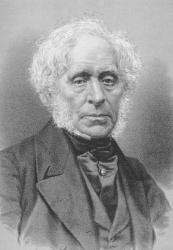
William John Macquorn Rankine
 Great Britain
- Biography of William John Macquorn Rankine
- William John Rankine passed away on December 24, 1872, in Glasgow.
Biography of William John Macquorn Rankine
William John Macquorn Rankine was a Scottish engineer and physicist who was born on July 5, 1820, in Edinburgh, into a family of engineers. He attended the Edinburgh Institute from 1836 to 1838. During these years, Rankine received a gold medal for his essay on the relative wave theory of light, and two years later, he was awarded an additional prize for another essay on relative methods of physical investigation. However, Rankine was unable to complete his education due to financial difficulties.
Shortly after leaving the institute, Rankine traveled to Ireland, where he became a pupil of Sir John Benjamin Macneill, a prominent civil engineer. During this period, Rankine developed the method of sending circular curves, which has since become known as "Rankine's method". In 1842, Rankine completed his apprenticeship and returned to Scotland, where he worked on railways and harbors until 1848. During this time, Rankine began presenting his developments at the Institution of Civil Engineers.
In 1848, Rankine embarked on a series of research in molecular physics. However, his most significant research and scientific works were conducted in the field of technical thermodynamics, establishing him as one of the founders of this branch of general physics. In 1849, independently of Clausius, Rankine derived the general equations of thermodynamics that express the relationship between heat and mechanical energy. He studied the thermodynamic properties of gases and steam in 1850 and compiled tables of water vapors that found wide application. In 1859, he constructed a complete theory of the steam engine.