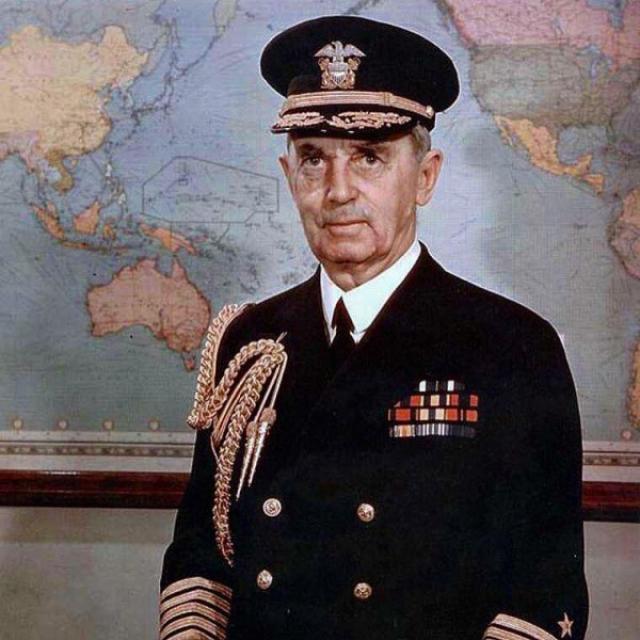
William Leahy
 USA
USA- William Daniel Leahy
- Naval Career
- Rise to Admiral
- Chief of Naval Operations and Beyond
- Personal Representative of the President
William Daniel Leahy
Early Life and EducationWilliam Daniel Leahy was born on May 6, 1875, in Hampton, Iowa. His father, a Civil War captain, instilled in him a sense of duty and patriotism. Leahy entered the United States Naval Academy in Annapolis in 1897 and graduated in 1907 from the Naval War College.
Naval Career
Leahy's naval career began during the Spanish-American War in 1898. He served in the Philippines (1899-91), China (1900), Nicaragua (1912), Haiti (1916), and Mexico (1916). During World War I, he commanded the USS Dolphin, carrying Assistant Secretary of the Navy Franklin D. Roosevelt, and the two men forged a close friendship.
In the interwar years, Leahy commanded the battleship USS St. Louis in Turkey and the 1st Destroyer Squadron. He served as Director of Personnel in the Bureau of Navigation from 1923-26 and commanded the battleship USS New Mexico. In 1927, he became Chief of the Bureau of Ordnance and in 1931, Commander of Destroyers.
Rise to Admiral
Leahy's career accelerated in the 1930s. In 1933, he became Chief of the Bureau of Navigation in Washington, D.C., and in 1935, he took command of the Battle Force, the U.S. Navy's primary strike force. In 1936, he was appointed Commander-in-Chief of the U.S. Fleet.
Chief of Naval Operations and Beyond
On January 2, 1937, Leahy became Chief of Naval Operations, the highest-ranking position in the U.S. Navy. He retired on August 1, 1939, but was soon appointed Governor of Puerto Rico by Franklin D. Roosevelt. Leahy found the position unfulfilling and was sent to France as U.S. Ambassador to the Vichy government in January 1941.
Personal Representative of the President
On July 20, 1942, Leahy was appointed personal representative of President Roosevelt on military affairs. His responsibilities were broad and influential, including chairing the Joint Chiefs of Staff meetings and acting as the liaison between Roosevelt and the U.S. Army's high command. Leahy ensured that the President's orders were carried out.
After World War II, Leahy remained in his post under President Harry Truman. He opposed the use of atomic weapons in August 1945. He retired on March 21, 1949, and wrote his memoirs, "I Was There" (1950). William Daniel Leahy died on July 20, 1959, and was buried in Arlington National Cemetery.