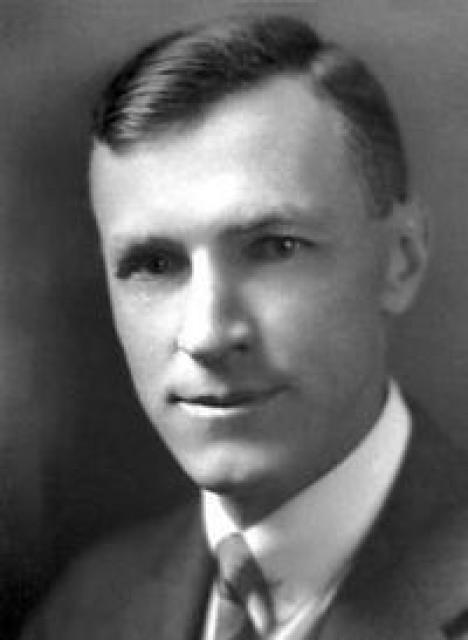
William Merfi
 USA
William Parry Murphy helped turn pernicious anemia from a nearly hopeless diagnosis into a treatable disease. Working with George Minot at Boston’s Peter Bent Brigham Hospital, he tested the idea that liver could restore blood production in patients with the illness. The treatment was demanding—early patients were asked to eat large amounts of liver—but the results changed medical practice and earned Murphy, Minot and George Whipple the 1934 Nobel Prize in Physiology or Medicine.
A Student of Medicine
Murphy was born on February 6, 1892, in Stoughton, Wisconsin, the son of Congregational minister Thomas Francis Murphy and Rose Anna Parry Murphy. He completed his early schooling locally and earned a bachelor’s degree from the University of Oregon in 1914. Before returning to school, he taught physics and mathematics in Portland high schools for two years.
He then began medical studies at the University of Oregon Medical School, where he also worked in the anatomy department. In 1919, he received the William Stanislaus Murphy Fellowship, which allowed him to transfer to Harvard Medical School. He earned his medical degree in 1922, completed an internship at Rhode Island Hospital and joined the staff of the Peter Bent Brigham Hospital in Boston.
The Liver Therapy Breakthrough
At the Brigham, Murphy worked with physician George Minot, who was investigating pernicious anemia, a severe disorder in which the body cannot make enough healthy red blood cells. Before effective treatment, the disease was usually fatal. The research grew from the work of pathologist George Whipple, who had found that liver helped dogs regenerate blood after blood loss.
Minot and Murphy tested a liver-rich diet in human patients. Murphy helped organize the clinical work and closely tracked the patients’ blood responses. At first, asking people to eat large quantities of raw liver was a hard sell. But patients who followed the regimen showed striking improvement, helping establish liver as an effective treatment. Later, more palatable liver extracts made the therapy easier to use.
The discoveries brought the three researchers together for the 1934 Nobel Prize in Physiology or Medicine. The award recognized their findings on liver therapy for anemia. Their work did not yet reveal the precise substance responsible: subsequent research identified vitamin B12 as the crucial factor, and B12 therapy eventually replaced the liver diet. The early clinical breakthrough nevertheless offered a lifeline to patients who had previously faced a disease with few prospects for recovery.
Murphy continued his work in medicine and blood disorders after the Nobel. He remained associated with the Brigham and Harvard Medical School, where he held senior clinical and teaching posts. His research interests included pernicious anemia, other blood diseases, leukemia and diabetes mellitus. In 1939, he published *Anemia in Practice: Pernicious Anemia*, reflecting the shift from a once-fatal condition to one physicians could manage with treatment.
Personal Life and Later Years
Murphy married Pearl Harriet Adams in 1919. They had two children: a son, William P. Murphy Jr., who became a physician, and a daughter, Priscilla, who died in 1936. Murphy’s career was closely tied to Boston’s medical community, particularly the Peter Bent Brigham Hospital, where he spent much of his professional life.
He lived to see the treatment he helped develop become a foundation for modern care of pernicious anemia. Murphy died on October 9, 1987, aged 95. His Nobel-winning work remains an example of how careful clinical observation can translate into a practical treatment—and how an initially unappealing idea can reshape a field when the evidence is strong.


