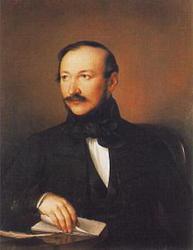
William Thomas Beckford
 Great Britain
- Biography of William Thomas Beckford
- Acquisition of Fonthill Abbey and Bibliophile
- Encounter with Mozart and Personal Life
- Writing Career and "Vathek"
- Later Life and Legacy
Biography of William Thomas Beckford
William Thomas Beckford was an English writer and politician who lived from 1760 to 1844. He was a member of Parliament from 1784 to 1793 and again from 1806 to 1820. Beckford inherited a vast fortune at the age of ten, including the estate of Fonthill in Wiltshire and sugar plantations in Jamaica, upon the death of his father. This allowed him to indulge in his passion for art, collecting, and various eccentricities throughout his life.
Acquisition of Fonthill Abbey and Bibliophile
Beckford's wealth enabled him to acquire the massive library of historian Edward Gibbon in Lausanne. He also commissioned the construction of Fonthill Abbey, a Gothic-style mansion, in 1807. The famous architect James Wyatt designed the abbey based on Beckford's drawings. Beckford lived at Fonthill Abbey, secluded from society, meticulously guarding his solitude.
Encounter with Mozart and Personal Life
At the age of five, Beckford met Mozart in London, and the two played piano together. Beckford was known to be bisexual, and he had several romantic relationships with men and boys. After rumors spread that he had seduced a minor, Beckford temporarily left England with his young wife, whom he married in 1783. Unfortunately, she died in 1786 during childbirth, leaving him with two daughters.
Writing Career and "Vathek"
Beckford's most famous work is the magical tale "Vathek," which he wrote in French in just three days and nights in 1782. This oriental-style story was later translated into English by Samuel Henley and published in 1786. "Vathek" became widely read and highly regarded by discerning critics. The book influenced notable authors such as Edgar Allan Poe, Thomas Moore, and Lord Byron. "Vathek" is considered the beginning of a literary movement known as "romantic orientalism."
Later Life and Legacy
In 1822, Beckford sold Fonthill Abbey and moved to Bath, where architect Henry Goodridge built a tower for him. This tower, known as Beckford's Tower, became his residence. Beckford passed away in 1844 and was buried in a cemetery in 1848, according to his wishes. Before his burial, his remains had been placed on top of a mound at his Lansdown Crescent estate, following a custom of the Saxon tribe, to which he claimed descent.
Beckford's travels through Italy, France, and Switzerland inspired his book "Dreams, Travel Thoughts, and Incidents" (1783), and he also wrote satirical works such as "Memoirs of Extraordinary Painters" (1780) and "Letters on Italy with Notes on Spain and Portugal" (1835). His contributions to literature, particularly with "Vathek," have left a lasting impact, and his books are still published and celebrated today. Conferences and exhibitions dedicated to Beckford continue to be held in countries such as the United Kingdom, France, Switzerland, Spain, and Portugal. He is considered one of the pioneers of the Gothic revival in literature.