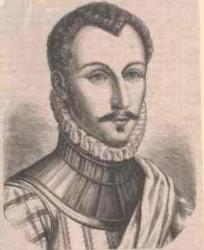
Wolfgang Fabricius Capito
 Germany
Wolfgang Fabricius Capito was an Alsatian humanist and theologian who became one of the leading Protestant reformers in Strasbourg. Trained in medicine, law and theology, he was also a skilled Hebrew scholar and a close associate of Erasmus. His work helped shape the city’s Reformation, while his willingness to engage with religious dissenters set him apart from some of his contemporaries.
From Köpfel to Capito
Born Wolfgang Köpfel in Hagenau, Alsace, in 1478, he was the son of a blacksmith. He studied at several universities, including Freiburg, where he pursued theology after earlier studies in other subjects. His Latin surname, Capito, was a scholarly form of Köpfel, while Fabricius also echoed the Latin word for a craftsman.
Capito became a priest and preacher, serving first in Bruchsal and then in Basel. From 1515 to 1520 he was a cathedral preacher and theology professor there, where he came into close contact with Erasmus and other humanists. His command of Hebrew supported his biblical scholarship; he published a Hebrew grammar and commentaries on the prophets Hosea and Habakkuk.
Reformation in Strasbourg
After a period in Mainz, Capito moved to Strasbourg in 1523. Alongside Martin Bucer, he became a central figure in the city’s religious transformation. He worked with civic leaders and preachers as Strasbourg adopted Protestant reforms, and he took part in efforts to bring German and Swiss Evangelicals into closer agreement.
Capito was notably open to discussion with religious radicals and, for a time, showed sympathy toward Anabaptists. He helped calm a peasant uprising and sheltered members of dissenting groups, including the Spanish theologian Michael Servetus. This approach caused tension with Bucer and other reformers who feared that dissent would undermine both church unity and public order. Capito’s position later hardened, and he publicly rejected Anabaptist teaching.
Scholar, Mediator and Family Man
Capito’s reforming work was not limited to Strasbourg. He travelled to synods and religious conferences, seeking agreement among Protestant groups divided over doctrine. His efforts at the 1532 Bern Synod helped him regain the confidence of fellow reformers who had questioned his theological sympathies.
In 1532, Capito married Wibrandis Rosenblatt, the widow of theologian Johannes Oecolampadius. They had five children together. After Capito died, Rosenblatt later married Martin Bucer, underscoring the close personal and intellectual ties linking the leading Reformation households.
Capito died of plague in Strasbourg on November 4, 1541. His legacy combines humanist scholarship with the practical work of building a reformed church. Remembered as a learned mediator, he also represents the uneasy boundary between early Protestant reform and the more radical movements that emerged alongside it.