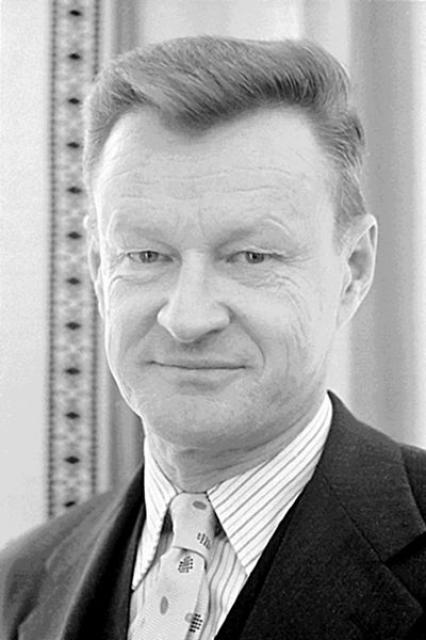
Zbignev Bjesinskiy
 USA
USA- Early Life and Education
- Academic and Government Career
- Political Advisor
- Later Years
- Views on Russia and American Hegemony
- Awards and Recognitions
Early Life and Education
Zbigniew Brzezinski was born in Warsaw, Poland, in 1928 into a Polish diplomatic family. However, other sources claim that he was born at the Polish consulate in Kharkiv, Ukraine, and registered as born in Poland to avoid hindering his future career. From 1938 onwards, he resided in Canada, eventually becoming an American citizen in the 1950s.
After graduating from McGill University with a master's degree, Brzezinski pursued his doctoral studies at Harvard University, earning a Ph.D. in political science in 1953. His doctoral dissertation examined the formation of a totalitarian system in the USSR.
Academic and Government Career
Upon completing his studies, Brzezinski embarked on an academic career, teaching at Harvard and later at Columbia University. In 1961, he established the Institute on Communist Affairs at Columbia.
In the mid-1960s, Brzezinski joined the State Department's policy planning council. He became a prominent advocate for the containment of communism, the theory of the technocratic era, and a new type of American hegemony.
Political Advisor
Throughout the 1960s, Brzezinski served as an advisor in the Kennedy and Johnson administrations, taking a hard line against the Soviet Union. He also advised Vice President Hubert Humphrey during the 1968 presidential campaign.
Following the election of President Jimmy Carter in 1976, Brzezinski was appointed National Security Advisor. As a strong supporter of the CIA's covert program to draw the USSR into a costly and distracting war in Afghanistan, he famously wrote to President Carter after the start of the Afghan War: "We now have the opportunity to give the Soviets their Vietnam War."
Later Years
During the Clinton presidency, Brzezinski contributed to the concept of NATO expansion eastward. Today, he serves as an advisor to the Center for Strategic and International Studies and is a professor of American foreign policy at Johns Hopkins University's School of Area and International Studies. He is also a member of various organizations and committees, including the Trilateral Commission, the American Academy of Arts and Sciences, and the American Committee for Peace in Chechnya.
Views on Russia and American Hegemony
Brzezinski views the United States as the world's sole hegemon, denying the possibility of other states achieving similar status. He considers the USSR/Russia as a defeated adversary, similar to Germany and Japan after their defeat in World War II.
Brzezinski argues that "American Eurasian geostrategy should focus on the shaping of states and cautious management of geopolitically pivotal states, responding to two equally important American interests: the preservation of America's global primacy in the near term, and its transformation into a more institutionalized global cooperative system in the longer term."
Awards and Recognitions
Presidential Medal of Freedom for his role in normalizing US-China relations and contributions to human rights policy and US national security.
Order of the White Eagle from the Republic of Poland for his contributions to restoring its independence.
Order of Prince Yaroslav the Wise, Third Class from the President of Ukraine.