Zhoze dush Santush
 Angola
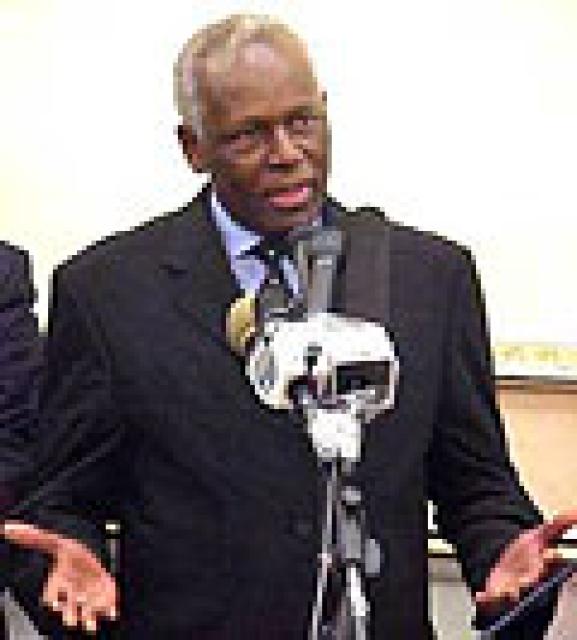
Biography of José Eduardo dos Santos
José Eduardo dos Santos was born on August 28, 1942, in Luanda, Angola. His father, Eduardo Avellino dos Santos, was a retired bricklayer, and his mother, Jassinta Jose Paulina, was a housewife. Both of his parents are now deceased. Dos Santos completed his primary education in Luanda and received his secondary education at the Salvador Correia National Lyceum.
In the early 1950s, while still a student at the lyceum, Dos Santos began his political activities. With the establishment of the MPLA (People's Movement for the Liberation of Angola), the national movement in the country gained new momentum. Dos Santos actively participated in the activities of underground groups created during that period in the suburban areas of Luanda.
The events of February 4, 1961, which marked the beginning of the armed struggle for national independence, led to a wave of brutal repression by Portuguese colonizers against the African population of Luanda. The MPLA made the decision to adopt new methods of resistance. Many young Angolans left the country to actively participate in the armed struggle for independence.
On November 7, 1961, Dos Santos secretly left Angola and traveled to Leopoldville, Congo, as part of a group of seven people. Due to his exceptional personal qualities, at the age of 20, Dos Santos simultaneously served as vice chairman of the MPLA Youth Organization, of which he was one of the founders, and the first representative of the MPLA in Brazzaville. In 1962, he became convinced that armed struggle was the main form of resistance against colonial rule and joined the ranks of the EPLA (the MPLA's partisan organization). In November 1963, as part of a group of MPLA scholarship holders, he went to study in the Soviet Union and enrolled at the Baku Institute of Oil and Gas. In June 1969, he obtained a degree in petroleum engineering.
During his time at the institute, Dos Santos supervised the political work among Angolan students in the Soviet Union and then became the leader of the Angolan student community. After defending his diploma, he was sent to a specialized military school in the Soviet Union, where he underwent a one-year military training course as a communication specialist. The knowledge he gained allowed Dos Santos to hold positions such as chief of the communication center of the Northern Front from 1970 to 1974 and later deputy chief of the communication service of the Second Military-Political District of the MPLA in Cabinda.
In 1974, Dos Santos was appointed a member of the Temporary Commission for the Reorganization of the Northern Front and chief of the financial service of the Second Military District. He was then reappointed as the MPLA representative in Brazzaville, where he continued to work until June 1975.
In September 1975, at the interregional conference of the MPLA held at the Eastern Front (Moshi), Dos Santos was elected a member of the Central Committee and the Politburo of the MPLA. He was entrusted with coordinating the political and diplomatic activities within the framework of the Second Military-Political District.
In June 1975, during the extremely complex period preceding the proclamation of national independence, Dos Santos was appointed coordinator of the Department of Foreign Affairs of the MPLA. He began organizing various diplomatic services in Luanda and actively engaged in diplomatic activities aimed at establishing relations with most African states. During this period, he also served as head of the Department of Health of the MPLA.
After the proclamation of independence of the People's Republic of Angola on November 11, 1975, Dos Santos was appointed Minister of Foreign Affairs. During his tenure as head of the Ministry of Foreign Affairs, Angola achieved full membership in the Organization of African Unity (OAU) in February 1976 and became a full member of the United Nations on December 1, 1976.
At the 1st Congress of the MPLA held in December 1977, Dos Santos was elected a member of the Central Committee and the Politburo of the MPLA – the Party of Labor. From 1977 to 1979, he served as Secretary of the Central Committee for Education, Culture, and Sports, then as Secretary of the Central Committee for National Reconstruction, and later as Secretary of the Central Committee for Economic Development and Planning. During the same period, until December 1978, he also held the position of First Deputy Chairman of the Council of Ministers. In December 1978, he was appointed Minister of Planning.
After the death of the first President of Angola, Agostinho Neto, on September 20, 1979, Dos Santos was elected Chairman of the MPLA – the Party of Labor. On September 21, 1979, he assumed the positions of Chairman of the MPLA – PT, President of the People's Republic of Angola, and Commander-in-Chief of the People's Armed Forces for the Liberation of Angola (FAPLA).
In November 1980, Dos Santos was elected Chairman of the People's Assembly – the highest organ of state power.
On December 17, 1980, at an extraordinary congress of the MPLA – PT, Dos Santos' authority to fulfill his duties in all the aforementioned state positions was confirmed. In the first half of the 1980s, he made the first attempts to implement political and economic reforms, which were severely hampered by the ongoing war in the country.
In 1985, at the 2nd Congress of the MPLA – PT, Dos Santos was once again confirmed in all his state positions.
From 1986 to 1992, Dos Santos focused on intensifying the process of peaceful settlement in the country. As a result, by 1992, the withdrawal of South African occupation forces from national territory was completed, and the return of the Cuban military contingent to their homeland was resolved.
In December 1986, Dos Santos was awarded the rank of Army General, the highest military rank in Angola.
During this period, in connection with changes in the international situation in the region and, in particular, with the proclamation of independence of Namibia, negotiations were initiated, resulting in the signing of a peace agreement in Bissau and the beginning of Angola's transition to political pluralism and the principles of a market economy. The signing of the agreement made it possible to organize and conduct democratic elections on a multiparty basis. As a result of the elections, the MPLA won the majority of seats in the highest legislative body of the country. Dos Santos received 49.57% of the votes. Due to the impossibility of holding a second round of elections, Dos Santos was reappointed as the President of the Republic of Angola.
Dos Santos has received numerous awards and honors in recognition of his achievements in creating a "free, democratic, and peaceful Angola." On April 29, 1993, he was awarded the Honorary Diploma of the National Institute of Freedom of the United States (INS).
Dos Santos has been honored with several high foreign awards and distinctions, including Honorary Diplomas from the National Commission for Racial Justice of the United Church of Christ (USA) and the Federal University of Brazil. He has also received awards from President Sam Nujoma of Namibia and President Omar Bongo of Gabon. In 1998, at the 4th Congress of the MPLA, Dos Santos was reelected as the party's chairman.
Among the most significant recent tasks facing the President of Angola, Dos Santos, were ensuring territorial integrity and achieving and maintaining peace in the country. These tasks were resolved through the signing of the Memorandum of Understanding in Luanda in April 2002, which complemented the Lusaka Protocol.
Dos Santos is a co-founder of the Community of Portuguese Language Countries (CPLP).
José Eduardo dos Santos is married to Ana Paula dos Santos and has three children. In his free time, he enjoys playing football, handball, and basketball. He also plays the guitar and drums and prefers light classical music. He is fond of literature, particularly Angolan authors.