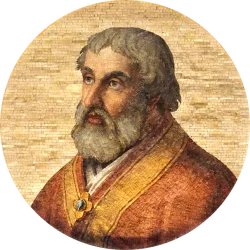
Adeodatus I
Adeodatus I, also known as Deusdedit, was bishop of Rome from 615 to 618. His papacy was brief, but it fell during a difficult stretch for the city, when Rome faced political uncertainty, an earthquake, and an outbreak of disease. He is remembered in church tradition for his care for the clergy and the sick, as well as for his place in the long line of early medieval popes.
A Roman Cleric
Adeodatus was born in Rome, though the exact date of his birth is unknown. He had served in the Roman clergy for many years before being elected pope. His name appears in sources in more than one form: Deusdedit and Adeodatus both mean “God has given,” and later lists sometimes use the names interchangeably.
He was elected after the death of Boniface IV and took office in October 615. The early seventh century was a period of upheaval across Italy. The Eastern Roman Empire retained formal authority over Rome, while Lombard powers and local political interests shaped the wider landscape. The pope’s role combined religious leadership with responsibilities for the welfare and administration of the city.
Pastoral Leadership
Accounts of Adeodatus emphasize his concern for the Roman clergy. Unlike some of his predecessors, who had favored monastic appointments, he promoted members of the diocesan clergy and is said to have left them a gift in his will. He also continued the church’s charitable work among Rome’s poor and vulnerable.
In August 618, an earthquake struck Rome, followed by an epidemic described in later sources as a skin disease. The crisis tested the city’s institutions and its religious leadership. Tradition remembers Adeodatus as aiding those affected, though the surviving record offers few details about the scale or organization of this relief.
An Early Papal Seal
Adeodatus is often credited with being the first pope to use a lead seal, or bulla, attached to official documents. The surviving evidence for this claim is limited, but the story has endured because the seals became an important feature of later papal correspondence. The term “papal bull” eventually came to refer to an official document named for the seal that authenticated it.
Death and Memory
Adeodatus died on November 8, 618, after a pontificate of just over three years. Later Catholic tradition honored him as a saint. The surviving accounts are sparse, yet they preserve a portrait of a pope whose authority was expressed through support for local clergy and care in a city struck by disaster.
His pontificate stands at a transition between late antiquity and the medieval papacy. The institution was still closely tied to Rome’s local needs, even as it operated within the competing political pressures of the Eastern Roman world and the Italian peninsula.