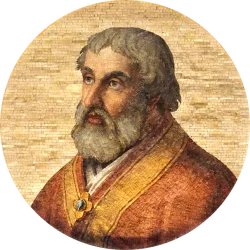
Sixtus III
Sixtus III served as bishop of Rome from 432 until 440, in a period when Christian leaders were still working through the sharp theological divisions of the previous generation. He approved the decisions of the Council of Ephesus and tried to mend relations between rival church leaders in the East. In Rome, he is also remembered for a major building program, especially the development of the basilica now known as Santa Maria Maggiore.
Before the Papacy
Little is known about Sixtus’s early life. He was already a prominent Roman cleric before his election, and surviving correspondence shows that he had been involved in disputes over Christian doctrine. Earlier in his career, Pelagian writers appear to have claimed his support. After Pope Zosimus condemned Pelagianism, however, Sixtus publicly aligned himself with that decision, a position welcomed by Augustine of Hippo.
The eastern churches were also divided over how to describe the relationship between Christ’s divine and human natures. The Council of Ephesus in 431 condemned the teachings of Nestorius and affirmed Mary’s title as Theotokos, or “God-bearer.” Sixtus became pope the following year, inheriting a church whose leaders remained deeply divided over the council’s aftermath.
A Papacy of Reconciliation
Sixtus confirmed the council’s acts and wrote to church leaders in the East. He supported the condemnation of Nestorius but also urged reconciliation with John of Antioch and his followers. An agreement between John and Cyril of Alexandria in 433 brought a temporary settlement, and Sixtus welcomed the renewed communion. His approach showed the limits and possibilities of papal influence: he could encourage compromise, but the eastern disputes were shaped by powerful local leaders and theological disagreements that Rome could not simply command away.
He also resisted efforts to readmit the Pelagian leader Julian of Eclanum to communion. In the west, questions about grace, human freedom, and the legacy of Pelagius remained contentious, and Sixtus maintained the church’s exclusion of Julian.
A Builder in Rome
Sixtus’s name is closely associated with the restoration and decoration of Roman churches. He repaired the older Basilica of Liberius on the Esquiline Hill and dedicated it to Mary. This church became Santa Maria Maggiore, one of Rome’s principal basilicas. Its mosaics, including the imagery on the triumphal arch, connect the church’s decoration with the Christological debates affirmed at Ephesus.
The architectural history of Santa Maria Maggiore spans several phases, and the building has undergone many later changes. Sixtus’s contribution was to shape and adorn the early Christian basilica at a moment when dedicating a major Roman church to Mary expressed both devotion and a theological position.
Death and Legacy
Sixtus died in 440, after about eight years as pope. Later Catholic tradition venerated him as a saint. His papacy was not defined by a single dramatic confrontation; its lasting marks were diplomatic efforts to restore unity after Ephesus and the church buildings that made Rome’s religious identity visible in stone and mosaic.