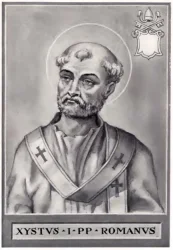
Adrian II
- A Roman Cleric Chosen Late in Life
- The Photian Dispute
- A Mission Among the Slavs
- A Difficult Pontificate
- A Legacy of Competing Priorities
Adrian II became pope at an advanced age, stepping into a dispute that had divided Rome and Constantinople over the patriarchate of the Eastern church. His pontificate was marked by attempts to restore papal authority in the East, but also by support for the mission of Cyril and Methodius among the Slavs. The contrasting strands of his policy reflected a papacy seeking influence across a politically fragmented Christian world.
A Roman Cleric Chosen Late in Life
Adrian was born in Rome around 792 into a clerical family. Before his election he had held important positions in the Roman Church and was regarded as a respected priest. He was elected pope in 867, after the death of Nicholas I. Adrian had reportedly declined the office more than once earlier in life, but this time accepted it, beginning a pontificate that would last until 872.
He inherited a complex relationship with the Byzantine Empire. The patriarchate of Constantinople was contested: Ignatius had been removed, and Photius appointed in his place. Pope Nicholas I had opposed the change, while Photius and a council in Constantinople had condemned the Roman position. The quarrel mixed questions of church authority with the political calculations of emperors and bishops.
The Photian Dispute
After Basil I took power in Constantinople in 867, Photius was deposed and Ignatius restored. Adrian sent papal representatives to a council held in Constantinople in 869–870. The assembly condemned Photius and supported Ignatius, decisions intended to resolve the conflict and reaffirm Rome’s authority. The settlement was temporary: after Ignatius’s death, Photius returned to the patriarchal office with the approval of Adrian’s successor, John VIII. The shifting outcomes show that the dispute was not simply a personal contest, but part of a longer struggle over jurisdiction and the balance between Rome and Constantinople.
A Mission Among the Slavs
Adrian’s pontificate also intersected with the Christian mission of the brothers Constantine, known as Cyril, and Methodius. They had developed a written form of Slavic for religious teaching and were working in Moravia, where the use of local language offered an alternative to services in Latin. The brothers came to Rome, where Adrian received them and supported their work. Cyril entered monastic life in Rome and died there in 869; Adrian backed Methodius’s continued mission and approved the use of Slavonic in worship.
The approval had wider significance. Christian leaders were competing for influence among Slavic communities, and the choice of language carried both religious and political meaning. Adrian’s support helped establish a lasting association between the Roman Church and the development of Slavic Christian literature, even as later relations in the region remained contested.
A Difficult Pontificate
Adrian also faced pressures closer to home. Relations between the papacy and western rulers required diplomacy, while violence and factional conflict threatened the safety of the Roman court. His office had spiritual authority but limited means to control powerful nobles and neighboring rulers. These challenges continued after his death in 872.
A Legacy of Competing Priorities
Adrian II is remembered for two different legacies: a hard-line effort to settle the Photian controversy on Rome’s terms and a willingness to support liturgical practice in a language beyond Latin. The first brought only a temporary victory, while the second strengthened a mission whose cultural influence endured. His pontificate illustrates how church policy in the ninth century was shaped by theology, language, and the political realities of competing empires.