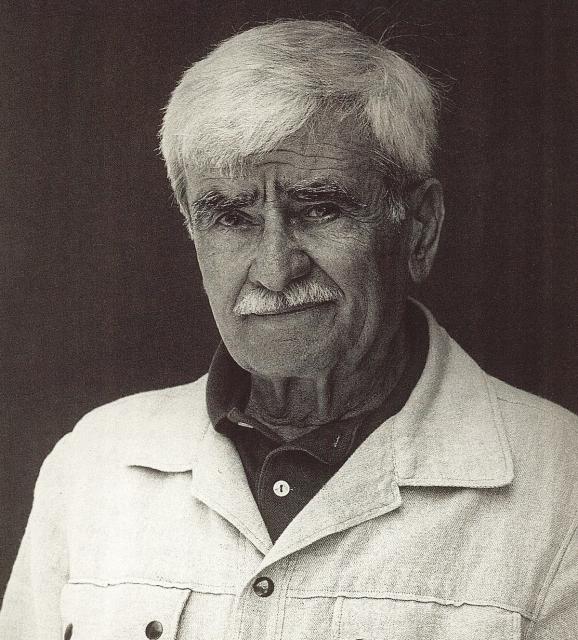
Alberto Burri
 Italy
ItalyBiography of Alberto Burri
Alberto Burri was an Italian artist known for his innovative use of materials and his abstract artworks. He was born in Città di Castello, Italy in 1915. Burri initially pursued a career in medicine and received his medical education at the University of Perugia. However, his life took a different turn when he became a military doctor during World War II.
During his service in the Italian army in North Africa, Burri was captured and held as a prisoner of war. He was sent to Hereford, Texas, where he continued his medical duties. It was during this time, in 1944, that Burri started to explore painting as a form of expression. After his release in 1945, Burri relocated to Rome.
In 1947, Burri had his first solo exhibition at Galleria La Margherita in Rome. Alongside his career as a painter, Burri also worked on stage designs for La Scala and other theaters. His contributions to the arts earned him the Italian Order of Merit in 1994.
Innovative Use of Materials
After settling in Rome, Burri began to experiment with abstraction and non-traditional materials. He created artworks using materials such as pumice, resin, and burlap, which gave his paintings a nearly three-dimensional quality. One of his notable works, "Sackcloth in Red" (1954) displayed at the Tate Gallery in London, featured splattered paint on fabric, resembling bloodied bandages.
Throughout the mid-1950s, Burri incorporated charred wood and welded metal sheets into his artwork. In the early 1960s, he started using burnt plastic as a medium. In the early 1970s, Burri began a series of cracked paintings called "cretti" (Italian for "cracks") and created a series of works using celotex (soundproofing cardboard) from 1979 to 1990.
These works, made from materials like "bloodied" burlap, charred wood, and rusted iron, reflected Burri's impressions of the horrors of war and brought him international recognition. He was one of the first artists to explore the associative potential of materials, prefiguring the junk art movement in America and the Arte Povera movement in Italy.
Grande Cretto
In the 1980s, Burri embarked on a land art project in the town of Gibellina in Sicily. The town had been abandoned in 1968 after an earthquake, and its residents were relocated 18 kilometers away. Burri covered a large portion of the old town, measuring approximately 300x400 meters, with white concrete. He named this work "Grande Cretto."
Alberto Burri passed away in 1995, leaving behind a significant legacy in the art world. His innovative use of materials and his exploration of abstraction continue to inspire artists to this day.


