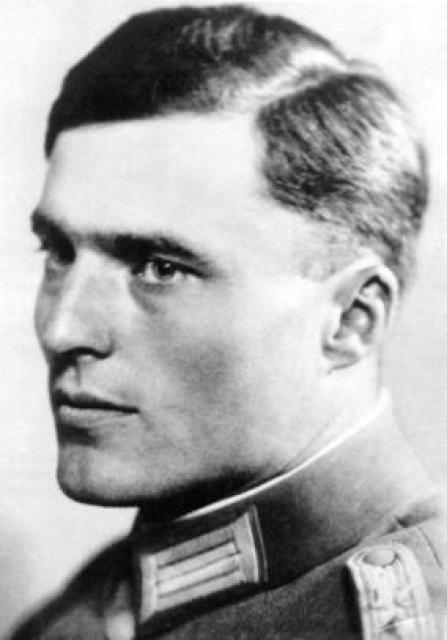
Claus Schenk Graf von Stauffenberg
 Germany
Biography of Claus Schenk von Stauffenberg
Claus Schenk von Stauffenberg was a German colonel and the leader of the assassination plot against Adolf Hitler on July 20, 1944. Born into one of the oldest aristocratic families in Southern Germany, Claus came from a close-knit aristocratic family that was closely connected to the royal house of Baden-Württemberg. His father held a high position at the court of the last king of Baden-Württemberg. Claus was the third son in the family, and his older brothers, Berthold and Alexander, also participated in the conspiracy.
Claus von Stauffenberg was raised in a Catholic and conservative household with strong German patriotism. He received an excellent education and had literary inclinations, but eventually chose a military career. He joined the army in 1926 and enthusiastically welcomed Hitler's rise to power in 1933, believing that the Nazi regime would bring about the revival of Germany. However, his attitude towards Nazi ideology changed as he witnessed the atrocities committed against Jews and the persecution of religious leaders in Germany.
At the beginning of World War II, Stauffenberg served as an officer in the Bavarian Cavalry Regiment and participated in the occupation of the Sudetenland, the Polish and French campaigns, and the German-Soviet front. In 1943, he was in North Africa where he suffered a severe injury in Tunisia, losing his left eye, his right hand, and two fingers on his left hand. Despite his injuries, Stauffenberg survived and returned to active duty. By this time, he had come to realize that Hitler was leading Germany to disaster. Wanting to save his country from disgrace and dishonor, Stauffenberg joined the conspirators plotting against the Führer.
The conspirators, a group of German generals and high-ranking officers, planned to assassinate Hitler and seize control of the General Staff in Berlin, hoping to negotiate a peace treaty and avoid Germany's ultimate defeat in the war. Stauffenberg played a crucial role in the conspiracy as he was responsible for establishing communication with the commanders of regular military units throughout Germany after the planned assassination and issuing orders for the arrest of local Nazi leaders and Gestapo officers. As the newly appointed Chief of Staff of the Reserve Army at Bendlerstrasse in Berlin, Stauffenberg was in a unique position to carry out this task. He was also the only conspirator who had regular access to Hitler himself.
On July 20, 1944, a meeting was scheduled to take place at Hitler's headquarters, the Wolf's Lair, near Rastenburg in East Prussia. Stauffenberg, accompanied by Major Joachim Kuhn and General-Major Henning von Tresckow, prepared two explosive devices concealed in a briefcase for the assassination. Stauffenberg was supposed to set the detonators and timers just before the attack. However, he discovered that the meeting had been rescheduled and would now take place in a wooden barrack on the surface instead of an underground bunker due to the heat. Pressed for time, Stauffenberg managed to arm only one of the explosive devices and placed the briefcase near Hitler before leaving the room on a pretense. He had five minutes left until the explosion.
Just seconds before the detonation, someone removed the briefcase, and Hitler was saved by the massive oak table shielding him from the blast. Out of the 23 people present in the barrack, 17 were injured, and four were killed. Hitler himself sustained only minor injuries. By that time, Stauffenberg had already left the Wolf's Lair and witnessed the explosion from a distance. Believing that the assassination had succeeded, he made his way to Rastenburg and flew to Berlin, where he informed General Friedrich Olbricht, another conspirator, of Hitler's death and insisted on implementing the "Valkyrie" plan. However, General Friedrich Fromm, the Commander-in-Chief of the Reserve Army, refused to sign the plan and instead called Hitler's headquarters to confirm his survival. Learning of the failed assassination attempt, Fromm abandoned the conspiracy and the arrest of the conspirators, including Stauffenberg, followed.
In an attempt to carry out his plan, Stauffenberg personally contacted military commanders across Germany and occupied territories, urging them to obey the orders of the new leadership, Generals Ludwig Beck and Adolf Heusinger, and carry out the arrests of SS officers and Gestapo agents. Some of the officers he contacted followed his instructions and began making arrests. However, due to confusion, haste, and uncertainty among the conspirators, many planned actions were not carried out or overlooked, and they failed to gain control over strategic points in the capital. The Berlin Military Command, loyal to Hitler, controlled the main buildings in central Berlin by the evening of July 20. Later that night, they captured the Bendlerblock, the headquarters of the Reserve Army, where Stauffenberg, his brother Berthold, and other conspirators were arrested. General Friedrich Fromm, who had been released from custody, immediately convened a military court and sentenced five people, including Claus von Stauffenberg, to death. The condemned were executed in the courtyard of the headquarters. Before his death, Stauffenberg shouted, "Long live sacred Germany!"
The remaining conspirators were handed over to the Gestapo. The next day, a special SS commission was formed to investigate the conspiracy, and thousands of presumed and actual participants were arrested, tortured, and executed. The tortures were filmed for Hitler's viewing pleasure. In modern Germany, July 20 is a day of mourning for the executed conspirators, and it is commemorated with solemn ceremonies. At the site of Stauffenberg's execution and his comrades, a solemn oath-taking ceremony is held by the military personnel. Since 2004, Claus von Stauffenberg has been officially recognized as a hero of the Resistance.
However, not everyone regards Claus von Stauffenberg as a hero or a true participant in the Resistance, both in Germany and abroad. Immediately after the war, many in Germany considered the conspirators as traitors rather than heroes, just as Stauffenberg had envisioned. This was fueled by the public shaming and humiliation the defendants endured during the trials. Foreign historians point out that the majority of the conspirators initially welcomed Hitler's rise to power and National Socialist ideology, including territorial expansion and the "Jewish question." It was the brutality and atrocities committed in Germany and occupied territories that they found unacceptable.


