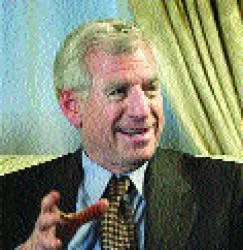
Alexander Dimitrov
Aleksandar Dimitrov moved from journalism into diplomacy during a period when Macedonia was reshaping its place in the world. After working in foreign-relations institutions in the Yugoslav republic of Macedonia, he became the foreign minister of the newly independent Republic of Macedonia. His two-year term coincided with the Kosovo crisis, intense regional diplomacy, and decisions that tested his country’s relationships with both neighboring states and major powers.
Journalism and the Road to Diplomacy
Born in Skopje on November 29, 1949, Dimitrov began his professional life in journalism. In the late 1960s, he helped found and edit an independent newspaper, and in 1972 he joined the youth paper Mlad Borec, where he worked as an editor until 1979. That early experience with public debate gave him a career outside the traditional diplomatic path.
In 1979, Dimitrov entered the institutions responsible for international relations in the Socialist Republic of Macedonia, then one of the republics within Yugoslavia. Over the next decade, he held senior administrative roles, including serving as a deputy and undersecretary in the Republic Committee for International Relations. As Yugoslavia broke apart and Macedonia declared independence in 1991, these institutions became the foundation of the country’s foreign ministry. Dimitrov’s experience made him part of the transition from a republic’s external-relations apparatus to the diplomacy of a sovereign state.
Foreign Minister During a Regional Crisis
Dimitrov became foreign minister on November 30, 1998, in the government led by Prime Minister Ljubčo Georgievski. He held the post until November 30, 2000. Macedonia was newly independent, seeking stronger ties with European institutions and NATO while managing sensitive relationships across the Balkans.
The Kosovo conflict became the defining regional challenge of his tenure. In 1999, Macedonia cooperated with NATO and the international community as the conflict intensified, while also facing a large influx of Kosovar refugees. Dimitrov publicly warned that the humanitarian emergency could create serious economic, social, and political strain for his country. In diplomatic statements, he supported a peaceful solution, respect for human rights, and autonomy for Kosovo within the borders of the Federal Republic of Yugoslavia. His public position reflected the difficult balance between international cooperation and concern about the conflict’s consequences for Macedonia and the region.
Another consequential episode came in January 1999, when his government established diplomatic relations with Taiwan, then known internationally as the Republic of China. The move opened commercial and political opportunities but also provoked a sharp reaction from Beijing and stirred debate within Macedonia. It illustrated the pressures facing a small state trying to attract international partners while navigating the rival claims of larger powers.
Return to Journalism
After leaving government, Dimitrov returned to the profession with which he had begun. In 2011, following more than three decades away from direct work in the media, he joined the daily newspaper Fokus as its diplomatic editor. He also revisited the early years of Macedonian independence in interviews, discussing how unprepared the country’s foreign-policy institutions had been for Yugoslavia’s rapid dissolution.
Dimitrov’s career bridged two distinct kinds of public service. His journalism helped shape debate in Macedonia before independence, and his government work placed him at the center of a period when the country had to define its foreign policy under intense regional pressure. His later return to the press brought that experience back into public discussion.