Alexander Divochkin
- Early Life and Career
- Military Service
- Heroism at Lake Myaarat
- Continued War Service
- Post-War Career and Legacy
Early Life and Career
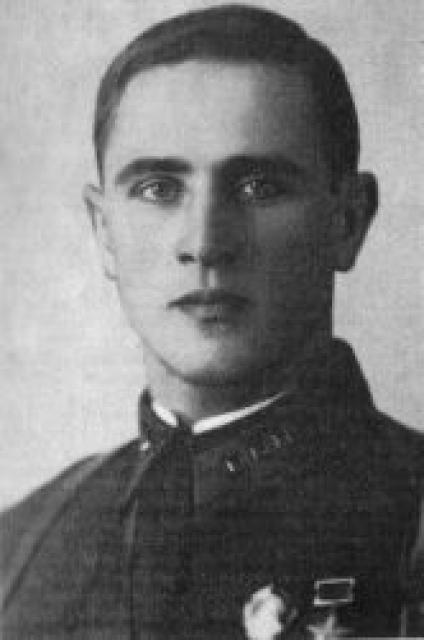
Alexander Alexandrovich Divochkin was born on August 20, 1914, in the village of Lopatino, Moscow Governorate, Russian Empire, to a working-class family. After completing seven years of school, he enrolled in the Kolomna Machine-Building Technical School. Divochkin worked at a felt factory and participated in the construction of the Voskresensky Chemical Plant before becoming a fitter on the Moscow Palace of Soviets project. He later relocated to the Middle Urals to help build a large-scale heavy-duty railway car factory.
Military Service
In 1936, Divochkin was conscripted into the Red Army and assigned to artillery units. Following his graduation from an artillery school in Moscow in 1940, he was promoted to junior lieutenant. Divochkin served in the Soviet-Finnish War of 1939-40 and later with the Border Troops on the northwestern border.
Heroism at Lake Myaarat
On July 25, 1941, during the Battle of Petrozavodsk, Divochkin's battery came under heavy fire from Finnish forces. Despite the danger, he took command, extinguished a fire in the ammunition depot, and personally operated two guns from an open position, repelling the enemy attack and destroying a gun, several machine guns, and up to a platoon of enemy infantry. For his actions, Divochkin was awarded the prestigious title of Hero of the Soviet Union.
Continued War Service
In 1943, Divochkin completed an accelerated course at the M.V. Frunze Military Academy. He participated in the elimination of the Demyansk salient and fought in the battles of the Kursk Bulge. In 1944, he played a key role in the liberation of Ukraine, Hungary, Austria, and Czechoslovakia.
Post-War Career and Legacy
After the war, Divochkin retired from military service with the rank of lieutenant colonel. He worked as a senior lecturer at the Moscow Polytechnic Institute until his tragic death in 1946. Divochkin is buried in the Vagankovo Cemetery in Moscow. He was awarded the Order of Lenin, the Order of the Patriotic War (1st and 2nd class), and several medals.