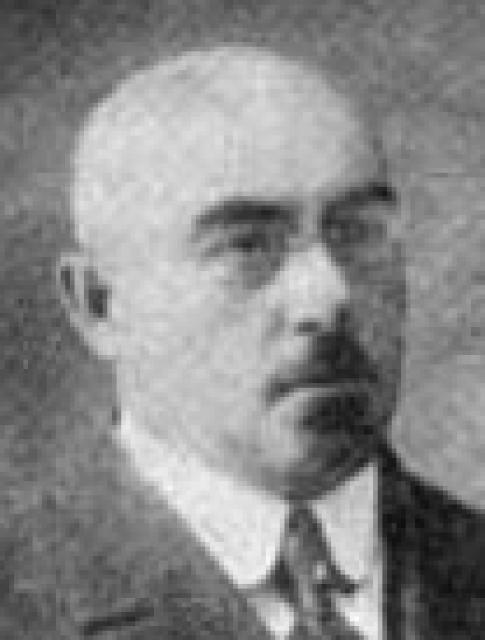
Alexander Hatisuan
 Armenia
Alexander Hatisian - Biography
Alexander Hatisian (17th February 1874, Tiflis - 10th March 1945, Paris) was the Prime Minister of the Republic of Armenia in 1919-1920. He was born into a prominent family and completed his education at the Tiflis State Gymnasium in 1891. Hatisian pursued medical studies at the Moscow (3 years) and Kharkov (2 years) universities, where he received his medical degree in 1897. In 1898, he traveled abroad to further his medical knowledge and conducted research in clinics, focusing on hygiene, public healthcare, and municipal affairs.
Returning to Tiflis in 1900, Hatisian became a member of the City Duma and an advisor to the Tiflis City Council. In 1905, he joined the "Armenian Revolutionary Federation (ARF) Dashnaktsutyun" party and actively participated in the revolution from 1905 to 1907. Hatisian held various positions within the Tiflis city administration, eventually becoming the Deputy Mayor of Tiflis in 1907 and the Mayor of Tiflis from 1910 to 1917. During the Peterhof trial in 1912, he testified as a witness. Hatisian also served as the President of the Caucasian Union of Cities from 1914.
As one of the organizers of the Armenian volunteer units during World War I and the aid to Armenian refugees affected by the 1915-1916 genocide, Hatisian was elected as the Deputy President of the Armenian National Bureau in Tiflis from 1915 to 1917. In December 1916, he conveyed a plan for a palace coup proposed by G.E. Lvov to Grand Duke Nicholas Nikolaevich. After the February Revolution in 1917, Hatisian joined the ARF Dashnaktsutyun party and became the head of the Armenian National Bureau until October 1917. He chaired the Armenian political party meetings in March and April and participated in the Transcaucasian Seim in June.
Hatisian advocated for a cautious approach to resolving the Armenian question, linking it to the stability and strengthening of democratic power in the center and the successful conclusion of World War I in the Caucasus. He actively supported the policies of the Provisional Government, including the slogan "War until Victory." Hatisian played a significant role in convening the Armenian National Consultation (Eastern Armenian Congress) and the establishment of the Armenian National Council from September to October.
In April 1918, with the formation of the Transcaucasian Democratic Federative Republic, Hatisian was appointed as the Minister of Finance and Food and also served as the Minister of Industry of the Transcaucasian Seim. He participated in peace negotiations with Turkey in Trebizond in February and Batumi in May. After the proclamation of the independent Republic of Armenia on 28th May, Hatisian, together with O. Kachaznuni, signed the Batum Peace Treaty on 4th June. From October 1919, he served as the Minister of Foreign Affairs and from August 1919 to May 1920 as the Prime Minister of the Republic of Armenia.
In the summer of 1920, as a member of the Provisional Government Bureau, Hatisian went abroad to organize internal loans and establish a "Golden Fund" for Armenia within the Armenian diaspora. On 2nd December, he signed the Alexandropol Treaty on behalf of the government, transferring power to the Armenian Bolshevik Revolutionary Committee. Hatisian emigrated to Paris and continued his political activities as part of the Armenian National Delegation, initially as the Deputy Chairman and later as the President. He participated in the Lausanne Conference (1922-23), representing and defending the interests of the Armenian people before the League of Nations.
During the occupation of Paris by Nazi troops, Hatisian moved to Portugal (Porto). In 1944, he was arrested by the local authorities based on an accusation but was soon released due to lack of evidence of collaboration with the Germans. Hatisian was also known as the author of articles on local self-government, medicine, economics, and culture, as well as a translator of Armenian literature.




