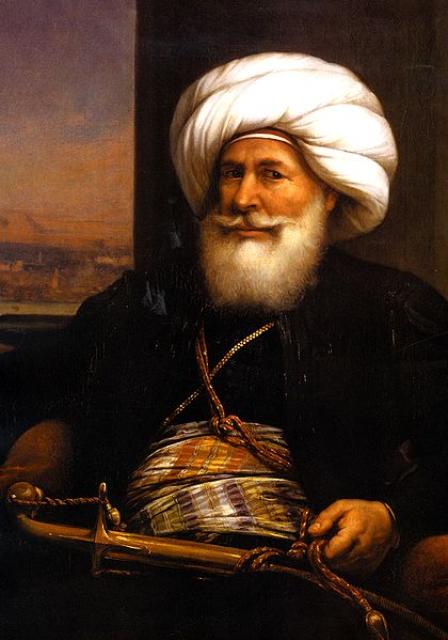
Ali Pasha Muhammad
 Egypt
Egypt- Biography of Ali Pasha Muhammad
- Reforms in Egypt
- Relations with Europeans and Expansion
- Conflict with the Ottoman Empire
- Conflict and Compromise
- Later Years
Biography of Ali Pasha Muhammad
Ali Pasha Muhammad was born into an Albanian family in Macedonia. He was sent to Egypt in 1798 by the Ottoman administration as the leader of an Albanian military detachment to fight against the French. His strong will, boundless ambition, and great abilities quickly elevated him from being a Mamluk to becoming the Pasha and Khedive (vice-king) of Egypt in 1805.
Reforms in Egypt
Under Muhammad Ali's leadership, Egypt experienced significant development. He surrounded himself with French advisors and, recognizing the superiority of European military organization over the Turkish army, decided to reform the army, government, and Egyptian society in a European manner. Although Muhammad Ali himself did not receive much education, he understood the value of knowledge and provided a good education to his sons Ibrahim Pasha and Said Pasha. He also established many schools, a printing press, and a newspaper in Egypt. However, his reforms, which caused dissatisfaction among conservative subjects, often resulted in harsh actions such as executions and secret killings.
Relations with Europeans and Expansion
In personal relations, particularly with Europeans, Muhammad Ali appeared as a gentle and humane person. His simplicity and approachability, combined with his ambition and ambition, appealed to Europeans who interacted with him. In 1823, Egypt captured Sudan and made it a province with its capital in Khartoum.
Transforming Egypt into a powerful state capable of supporting the Ottoman Empire with troops and a navy, Muhammad Ali participated in suppressing the Greek uprising. Although his fleet, together with the Turkish fleet, was defeated in the Battle of Navarino in 1827, he managed to recover by 1830. During the Russo-Turkish war of 1829-1830, Muhammad Ali stopped paying tribute to Mahmud II and openly rebelled in 1831, aiming to create an independent hereditary state from Egypt.
Conflict with the Ottoman Empire
Muhammad Ali's adopted son Ibrahim Pasha led the Egyptian forces into Ottoman-controlled Syria and besieged the fortress of Saint-Jean d'Acre. With its fall, Turkish Syria came under the control of the Egyptian ruler. The Sultan declared Muhammad Ali a rebel and sent an army led by Hussein Pasha to the Syrian borders. While the siege of Acre was underway, Ibrahim Pasha conquered the entire central part of Palestine, and the tribes of Lebanon joined him in the hope of liberation from Turkish rule. Ibrahim Pasha defeated Hussein Pasha at Goma and at the Beidan Pass (in the mountains between Syria and Cilicia).
The Sultan sent a stronger army under the command of his best general, Reshid Pasha. However, Reshid Pasha was also defeated at Konya and captured. Muhammad Ali planned to bring his troops to Turkish territories in Europe, but Russian intervention prevented this. Muhammad Ali recalled Ibrahim Pasha from Asia Minor and moderated his demands. In 1833, a treaty was signed in Kutahya, granting Muhammad Ali southern Syria as a vassal possession and temporary control over the Adana district.
Conflict and Compromise
In 1839, Muhammad Ali's failure to comply with the Kutahya treaty led to another rupture with Turkey, but this time the Ottoman Empire failed to defeat him. The Sultan's army, with Helmuth von Moltke among its ranks, was defeated at Nisibis, and Turkish Admiral Ahmed Fevzi surrendered the Turkish fleet to the Egyptians.
Muhammad Ali demanded hereditary authority over Egypt, Syria, Adana, and Crete from Abdulmejid, the successor of Mahmud II. In order to maintain peace, European countries, including France, proposed submitting this issue to the judgment of European powers. After the Sultan's agreement, a conference was held in London with representatives of the five major powers, which awarded Muhammad Ali the southern part of Syria and granted him hereditary authority in Egypt, subject to his unconditional submission to the Sultan and continued payment of tribute. Muhammad Ali rejected the conference's decision. As a result, a combined Anglo-Austrian fleet approached Alexandria and forced Muhammad Ali to accept the conference's outcome. He only retained control over Egypt and was forced to resume tribute payments to the Porte in 1840.
Later Years
While Ali Pasha Muhammad displayed unbridled bravery and military ambition in his youth, he transformed into a wise and visionary statesman in his mature years. He embarked on a series of grand projects aimed at glorifying his name in Europe and for future generations. Although he entertained the idea of constructing a canal through the Suez Isthmus, he hesitated to pursue it for fear of the canal's detrimental impact on Egypt's independence. In the early 1840s, he took several steps to develop irrigation in the country, but financial difficulties hindered their success. Financial failures were likely the main cause of his nervous breakdown, which led to his insanity. In 1844, he appointed his co-ruler Ibrahim Pasha, but Ibrahim died before Muhammad Ali's death. His grandson Abbas Pasha succeeded Muhammad Ali.