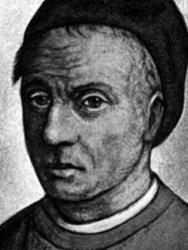
Ambrose Edward Barlow
 Great Britain
- Biography of Ambrose Edward Barlow
- Conversion and Education
- Life as a Priest
- Arrest and Martyrdom
- Canonization
Biography of Ambrose Edward Barlow
Early LifeAmbrose Edward Barlow was born in 1585 at Barlow Hall, located in Chorlton-cum-Hardy, one of the suburbs of Manchester. He was the fourth son of Sir Alexander Barlow and his wife Mary Barlow. The Barlow family reluctantly conformed to the Anglican Church after the Roman Catholic Church was prohibited in Great Britain. Ambrose's grandfather died in 1584 while imprisoned for his religious beliefs, and Sir Alexander Barlow lost two-thirds of his inheritance, which were confiscated under the new state religion.
Conversion and Education
On November 30, 1585, Ambrose was baptized in Didsbury Parish Church and remained a follower of the Anglican faith until 1607 when he converted to Catholicism. In 1597, ten years prior to his conversion, Ambrose was taken in by his relative Sir Uryan Legh, who cared for him while he trained as a page. However, after completing this service, Ambrose realized that his true calling was priesthood. He then traveled to Douai, France, where he became a student at the English College, a Catholic seminary. He later transferred to the Royal College of Saint Alban in Valladolid, Spain, which trained Catholic priests for England and Wales during the Reformation.
Life as a Priest
In 1615, Barlow returned to Douai, where he became a member of the Benedictine order and was ordained as a priest in 1617. After his ordination, Ambrose returned to Barlow Hall before settling in Morleys Hall in Astley, the home of Sir Thomas Tyldesley. Sir Thomas's grandmother arranged a sort of boarding house for the priest, allowing him to fulfill his duties as a pastor among the poor Catholics of his parish. There, he secretly celebrated daily Mass, delivered sermons, and performed prayers. To avoid detection by Protestant authorities, he developed a special routine where he traveled throughout the parish for four weeks and then stayed at the manor house for an additional five weeks. He frequently visited his relatives, the Downes, at their residence, Wardley Hall, and conducted masses for the gathered congregation.
Arrest and Martyrdom
Ambrose was arrested multiple times during his travels. On March 7, 1641, King Charles I issued a proclamation ordering all Catholic priests to leave the country within a month or face arrest and execution as traitors. Ambrose's parishioners pleaded with him to flee or at least go into hiding, but he refused. Their fears were heightened by the fact that the 56-year-old priest had suffered a stroke and was partially paralyzed.
On April 25, 1641, Easter Sunday, Barlow and his congregation of around 100 people were surrounded in Morleys Hall by four hundred armed men led by the Vicar of Leigh. Father Ambrose surrendered, and his parishioners were released after their names were recorded. Accompanied by sixty people, the priest was first taken before Judge Robert Heath and then to Lancaster Castle.
On September 7, Father Ambrose appeared before Judge Robert Heath, defending his actions. The next day, on the feast of the Nativity of the Blessed Virgin Mary, Heath found Ambrose Barlow guilty and sentenced him to death. Two days later, Ambrose Barlow was taken to the place of execution, hanged but not until death, disemboweled, quartered, and boiled in hot oil. His severed head was displayed for public viewing.
Canonization
On December 15, 1929, Pope Pius XI beatified Father Ambrose Barlow during a ceremony at St. Peter's Basilica in Vatican City. Then, on October 25, 1970, Pope Paul VI canonized Ambrose Barlow as one of the 40 British martyrs executed during the Reformation, mostly during the reign of Elizabeth I.
There are two portraits of Ambrose Barlow and one of his father, Sir Alexander. His relics and skull are also preserved.