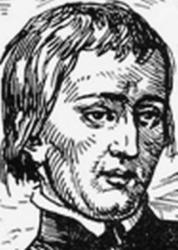
Jozef Baka
 Poland
Early Life and Education
Ksiądz Baka was a Polish Jesuit priest, missionary, and poet of the late Baroque period. Little is known of his life, and no portraits of him have survived. He was born into Lithuanian nobility.
In 1723, Baka joined the Jesuit Order and studied at the Jesuit Academy in Vilnius.
Teaching and Missionary Work
Baka taught at various Jesuit colleges in Belarus and Lithuania. From 1735 to 1739, he taught rhetoric at the Vilnius Academy.
For over twenty years, Baka served as a missionary in Lithuania and Belarus. In 1768, he settled in Vilnius.
Literary Career
Baka published several books of spiritual prose in Latin and Polish, including "Comitia honorum Ioannis Ludovici Plater" and "Wielki obrońca upadłych grzeszników przed Bogiem sprawy św. Jana Franciszka Regis."
He also published two collections of poetry, "Uwagi rzeczy ostatecznych i złości grzechowej" and "Uwagi śmierci niechybnej wszystkim pospolitej" (both published in 1766).
Posthumous Recognition
During his lifetime, Baka's poems were considered amusing oddities. The term "poetry à la Baka" became synonymous with nonsensical verse.
However, after the reprinting of his work by Władysław Syrokomla in 1855, Baka's reputation grew steadily in the late 19th and early 20th centuries. He became a favorite of the "Skamander" poets, the futurists (Aleksander Wat), and the catastrophists (Czesław Miłosz).
Today, Baka is recognized as a major poet of the late Baroque period in the Grand Duchy of Lithuania. His poetry has been compared to the metaphysical lyrics of John Donne and other English poets. One of the most recent editions of his work was illustrated by Jan Lebenstein in 2000.