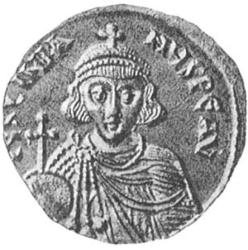
Andronik I Komnin
Andronikos I Komnenos was one of the most dramatic and divisive rulers in Byzantine history. A restless prince who spent years in exile and prison, he returned to Constantinople in 1182 claiming to defend a child emperor. Within a year he had taken the throne for himself. His government tried to curb corrupt officials and powerful landowners, yet it also became synonymous with purges, political executions, and the destruction of the Komnenian dynasty.
A Prince in the Komnenian Court
Andronikos was born around 1118–1120, the son of Isaac Komnenos and a nephew of Emperor John II. He grew up alongside his cousin Manuel, who became Emperor Manuel I in 1143. The two were close in youth, but Andronikos never settled easily into the imperial hierarchy. He was entrusted with military and provincial responsibilities, including a campaign in Cilicia that failed, and his relationships with the court grew increasingly strained.
His early life became a sequence of intrigue and reversals. After being suspected of plotting with Hungary against Manuel, Andronikos was imprisoned in Constantinople in 1155. He escaped more than once and eventually fled the empire, finding shelter at the court of Yaroslav Osmomysl in Galicia. He later returned to imperial service, but another dispute sent him back to the eastern provinces. He spent years moving among courts and territories around Byzantium, often outside the emperor’s control. Chroniclers also reported several romantic entanglements that intensified court scandals; the most consequential was his long relationship with Theodora Komnene, a relative of Manuel and widow of King Baldwin III of Jerusalem. The couple had two children and lived in exile before Andronikos’s eventual return.
The Road to Power
When Manuel I died in 1180, his young son Alexios II inherited the throne. The government was led by Alexios’s mother, Maria of Antioch, and a senior court official. Their regency faced opposition from aristocrats and popular suspicion of its close ties to Latin advisers and merchants. In 1182, a faction at court invited Andronikos to return as a protector of the boy-emperor. He marched toward Constantinople, presenting himself as Alexios’s champion and attracting support from officials and the public.
The takeover quickly turned bloody. In April 1182, violence against the Latin community in Constantinople erupted into a massacre. Latin merchants, clergy, and other residents—many of them Pisan and Genoese—were killed, and the Latin quarters were attacked. Andronikos used widespread hostility toward foreign influence to consolidate his position, but his arrival did not bring the political restraint his supporters had hoped for. He imprisoned Maria of Antioch and ordered the execution of other rivals.
In September 1183, Andronikos was crowned co-emperor. He then had Alexios II strangled and assumed sole power. He married the boy’s widow, Agnes of France, who was about twelve years old. Andronikos was in his sixties. The marriage cemented his claim to the throne while underscoring the ruthless dynastic logic of his rule.
Reform and Repression
Andronikos’s government addressed a real grievance: powerful officials and provincial magnates often exploited ordinary people and treated public offices as private property. He tried to stop the sale of revenue-collection posts, choose administrators on merit, and restrain abuses in taxation. Some contemporary accounts praised his attention to complaints from the provinces and his efforts to make government more accountable.
Those measures came with a brutal cost. The landowning aristocracy resisted, and Andronikos answered revolts with executions, confiscations, blinding, and imprisonment. His campaign against the old political elite broadened into a climate of fear in which suspicion could be fatal. The reforms won him support among some ordinary citizens, but his reliance on terror alienated potential allies and left the empire vulnerable to instability.
Fall and Death
The crisis sharpened in 1185 when a Norman invasion captured Dyrrhachium and then sacked Thessaloniki, the empire’s second-largest city. The disaster turned the mood in Constantinople against Andronikos. In September, he ordered the arrest of Isaac Angelos, a nobleman linked to an earlier revolt. Isaac killed the official sent to seize him and took refuge in Hagia Sophia, where a popular uprising gathered around him.
Andronikos attempted to flee by sea, but was captured. The crowd subjected him to days of torture and mutilation before killing him in the Hippodrome on September 12, 1185. His death ended the rule of the Komnenian dynasty in Constantinople. Isaac II Angelos became emperor, and Andronikos’s son John, who had briefly been named co-emperor, was also killed by his own troops.
Legacy
Later Byzantine writers portrayed Andronikos as a tyrant, and the violence of his final years gives that judgment a powerful basis. Yet his short reign also exposed how deeply tax abuse and aristocratic control had damaged the empire. His attempts to rein in those practices were real, but he pursued them through methods that destroyed trust and political cooperation. Andronikos remains difficult to reduce to either reformer or despot: he was both a critic of entrenched corruption and a ruler who used extreme violence to hold power, with consequences that outlasted his brief reign.