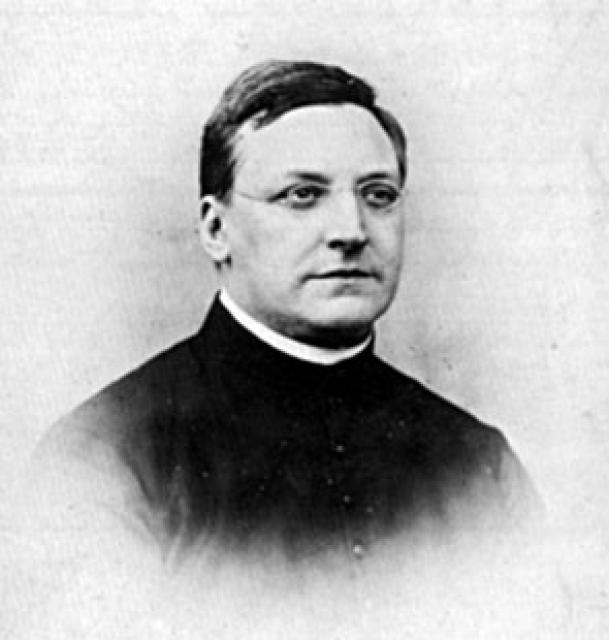
Angelo De Santi
 Italy
Italy- Father Luigi De Sanctis: A Pioneer in Musicology
- Early Life and Education
- Contributions to Cecilianism
- Influential Ideas
- Foundation of "Rassegna Gregoriana"
- Mentor and Influencer
- Legacy
Father Luigi De Sanctis: A Pioneer in Musicology
Luigi De Sanctis, an erudite Italian priest and musicologist, left an enduring legacy on the study and preservation of medieval церковной музыки.
Early Life and Education
Born into the Jesuit order, De Sanctis pursued his musical studies in France and Austria. He became a professed member of the order in 1877 and served in Trieste and Zara before being summoned to Rome by Pope Leo XIII to further his musicological research.
Contributions to Cecilianism
De Sanctis dedicated himself to delving into the history of medieval церковной музыки, particularly Gregorian chant. His work aligned with the Cecilian movement, which sought to revive traditional церковной music against the backdrop of more modern, concert-oriented styles.
Influential Ideas
In a series of articles published in "La Civilt? Cattolica" (1887-1892), De Sanctis expounded groundbreaking ideas. Notably, he drew parallels between Gregorian chant and Richard Wagner's leitmotif technique, a bold comparison for the time.
Foundation of "Rassegna Gregoriana"
With the support of Cardinal Carlo Respighi, De Sanctis established the influential historical music journal "Rassegna Gregoriana" in 1902. This publication became a beacon for scholars and musicians interested in early music.
Mentor and Influencer
De Sanctis's influence extended to a circle of Italian musicians dedicated to preserving ancient music, including Giovanni Tebaldini, Oreste Ravanello, Marco Enrico Bossi, and Lorenzo Perosi. Their shared passion for historical music shaped the course of Italian music research and performance.
Legacy
Father Luigi De Sanctis's dedication to the study and promotion of early церковной music continues to inspire musicologists and musicians today. His pioneering ideas and unwavering commitment to tradition have left an enduring mark on the understanding and appreciation of medieval церковной music.