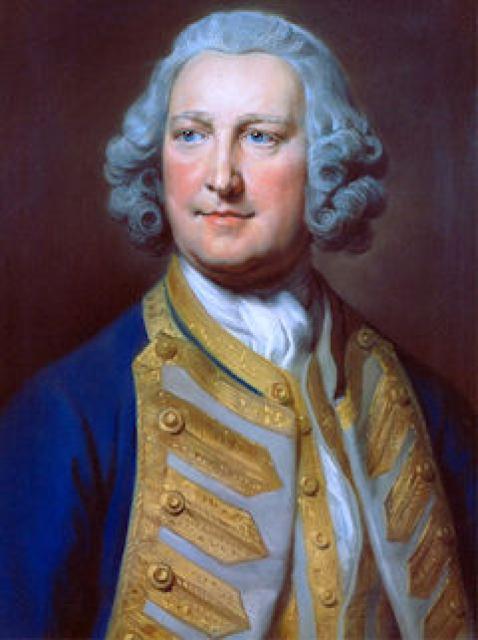
Anson George
 Great Britain
- Early Life and Naval Career
- Expedition Around the Globe
- Raid on Spanish Territories
- Journey to the East Indies
- Return to England and Recognition
- 1744:He was appointed to the Admiralty Board.
- Legacy
Early Life and Naval Career
George Anson was born on April 23, 1697, in Shugborough, Staffordshire, England. In 1712, he joined the Royal Navy and became a captain in 1723.
Expedition Around the Globe
August 1739:Anson was appointed commander of a squadron sent to raid Spanish colonies in the Pacific Ocean. The squadron consisted of the 60-gun "Centurion," the 50-gun ships "Gloucester" and "Severn," the sloop "Tryal," and two auxiliary supply ships.
September 1739:The expedition departed England and faced severe storms off the coast of South America. The "Severn" and "Pearl" sank, and the remaining four ships were scattered.
January 1741:After reaching the island of Juan Fernández, Anson regrouped his ships and initiated a period of rest and recovery for his ailing crew.
Raid on Spanish Territories
December 1741:With his sailors recovered, Anson sailed to the Bay of Panama. He raided the town of Paita, intending to capture Panama. However, he was unsuccessful due to Admiral Vernon's failed attack on Cartagena.
June 1742:Anson pursued Spanish galleons across the Pacific Ocean, but his search proved fruitless. He captured three Spanish ships and burnt them.
Journey to the East Indies
September 1742:Anson reached Macao (now Macau), the first friendly port they encountered during their voyage. He acquired provisions and supplies.
April 1743:He set sail for the Philippines, intent on intercepting a Spanish galleon returning from Acapulco.
June 1743:Anson's crew defeated the heavily armed Spanish galleon, seizing a large amount of treasure worth £400,000.
Return to England and Recognition
December 1743:He arrived in Canton and sold the treasure.June 1744:Anson's "Centurion" returned to England after a four-year voyage. He was promoted to rear-admiral.
1744:He was appointed to the Admiralty Board.
Wars and Naval Reforms1744-1748:In the War of the Austrian Succession, Anson commanded Anglo-Dutch ships against Spain and France.
1747:He led the English victory at the Battle of Cape Finisterre and was awarded the title of baron.
1756-1763:During the Seven Years' War, Anson commanded a squadron during the failed landing at Saint-Malo.
1751-1756, 1757-1762:He served as First Lord of the Admiralty, implementing reforms including naval inspections, a classification system for ships, and a standardized uniform for officers.
Legacy
George Anson died on June 6, 1762, in Moor Park, Hertfordshire. He was known as the "Father of the Navy" for his significant contributions, including the establishment of the Royal Marines. His name has been borne by seven ships of the Royal Navy.


