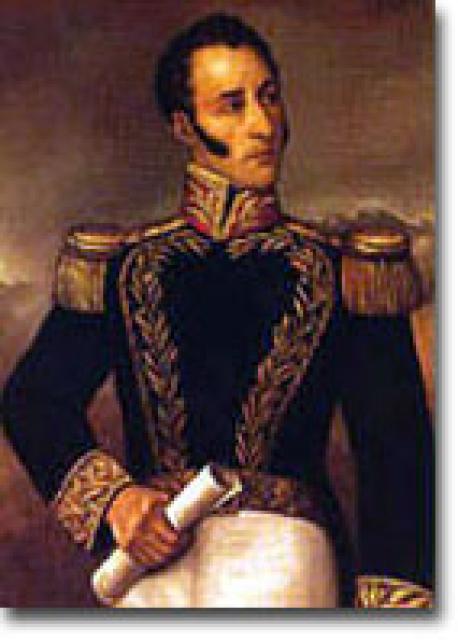
Antonio Chose Sukre
 Venezuela
Biography of Antonio Jose de Sucre
Antonio Jose de Sucre was born on February 3, 1795, in New Granada (now Venezuela). At the age of 15, Sucre joined the fight for independence in Venezuela and Colombia. He displayed outstanding military tactics and in 1820, he was appointed chief of staff by the leader of the independence movement, Simon Bolivar.
Under Bolivar's protection, Sucre was promoted to the rank of general and was given the command to liberate Great Colombia (now Ecuador) from the Spanish army. Leading a small army, Sucre launched a surprise attack around the Gulf of Guayaquil and proclaimed that territory as a protectorate of Colombia. His army then advanced to Quito, the modern-day capital of Ecuador, which is situated at an altitude of 3000 meters above sea level.
On May 24, 1822, the Spanish royal troops defending the city were defeated. Following this victory, Sucre's army turned southeast and merged with Bolivar's army, achieving several joint victories. In 1824, Bolivar handed over command of his army to Sucre, who completed the liberation of Peru and Upper Peru (now Bolivia).
After the colonies were liberated, Sucre became the president of Bolivia. In this position, he attempted to enact various economic and political reforms, including the expropriation of land from the Roman Catholic Church and the establishment of a universal secondary education system. However, in 1828, opposition intrigues and a local uprising forced Sucre to resign and return to Ecuador.
He assisted in defending Great Colombia against Peruvian attacks in 1829 and in 1830, he was called upon to lead the Congress convened by Bolivar, known as the "Great Congress." The purpose of this Congress was to unite Ecuador, Colombia, and Venezuela into a federal state. However, upon Sucre's return to Ecuador from the Congress, he was assassinated. It is believed that his killers were sent by Jose Maria Obando, a Colombian opponent of Bolivar, but no evidence was ever found.