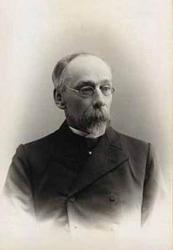
Arkadiy Langman
- A. Ya. Langman: A Distinguished Soviet Architect
- Early Career
- Participation in Moscow's Development
- Fruitful Period (1927-1932)
- Travel and Inspiration
- Later Years
- Legacy
- Awards and Recognitions
- NKVD Headquarters (1928-1933, Myasnitskaya Street, Moscow)
- Residential Building (1935, Bolshoi Zlatooustinsky Lane, Moscow)
- Residential Building (1951, Orlikov Lane, Moscow)
A. Ya. Langman: A Distinguished Soviet Architect
Early Life and EducationArkadi Yakovlevich Langman was born in 1886 in Kharkiv, Ukraine, to a Jewish family. His father's profession as a builder sparked his interest in architecture. From 1904 to 1911, Langman pursued his architectural studies at the Vienna University of Technology.
Early Career
After graduating, Langman returned to Russia and worked in Saint Petersburg for two years. In 1913, he moved back to Kharkiv, where he gained experience in local architecture and private practice.
Participation in Moscow's Development
In 1922, Langman arrived in Moscow to work on the Kashira Power Station. He later joined the Standardstroy organization, where he focused on designing standardized wooden structures for residential and public buildings. Notably, he contributed to the Central Forestry Department Pavilion at the 1923 All-Russian Agricultural Exhibition.
Fruitful Period (1927-1932)
In 1927, Langman became chief architect of the Stroydombureau. This marked the most prolific phase of his career, during which he designed 13 buildings. Among his notable works are the Dynamo Stadium, the Council of Labor and Defense Building, and the NKVD Headquarters (now known as the Russian State Duma).
Travel and Inspiration
Langman traveled to Germany, France, and the United States between 1930 and 1931. These international experiences broadened his perspective and informed his architectural style.
Later Years
Langman lived in the house he designed in Maly Leveshinsky Lane, Moscow. He continued to practice architecture throughout his life, including the 1947 Cooperative Residential Building, which became a hub for architects and government officials. Langman passed away in 1968 and was buried in the Novodevichy Cemetery alongside his daughter.
Legacy
Langman's work is characterized by its functionalism and innovative use of building materials. He played a significant role in shaping the architectural landscape of Moscow and beyond. His nephew, Eleazar Langman, became a renowned photographer.
Awards and Recognitions
Order of the Red Banner of Labor (1956)Notable Projects
People's House named after V.G. Korolenko (1922-1923, Poltava)
Central Forestry Department Pavilion (1923, Moscow)
Residential Building (1923, Milyutinsky Lane, Moscow)
House of the Gostorg (1925, Myasnitskaya Street, Moscow)
Dynamo Stadium (1927-1928, Leningrad Prospect, Moscow)
Residential Building (1927-1928, Prospekt Mira, Moscow)
Stroibureau House (1928, Bolshevo)
Residential Building for Dynamo Sports Society (1928-1931, Bolshaya Lubyanka Street, Moscow)
NKVD Headquarters (1928-1933, Myasnitskaya Street, Moscow)
Bolshevo Labor Commune Building (1930, Bolshevo)Council of Labor and Defense Building (1932-1935, Ulitsa Okhotny Ryad, Moscow)
Residential Building (1935, Bolshoi Zlatooustinsky Lane, Moscow)
Administrative Building Proposal (1938, Kiselny Lane, Moscow)Cooperative Residential Building for Architects and Builders (1947, Maly Leveshinsky Lane, Moscow)