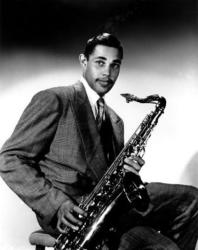
Artie Shaw
 USA
USA- Biography of Artie Shaw
- Early Life and Musical Influences
- Formation of Artie Shaw and His Orchestra
- Success and Career
Biography of Artie Shaw
Artie Shaw, born Arthur Jacob Arshawsky on May 23, 1910, in New York and passed away on December 30, 2004, in Los Angeles, was an American jazz clarinetist, conductor, and composer. He was one of the greatest musicians of the swing era.

Early Life and Musical Influences
Artie Shaw grew up and studied music in New Haven, Connecticut. In 1925, he joined Johnny Cavallaro's dance orchestra as a saxophonist. The following year, he began playing the clarinet, which soon became his primary instrument. From 1926 to 1929, he worked in Austin Wylie's orchestra, where he also arranged music. He then played the saxophone for Irving Aaronson and participated in jam sessions with local musicians in Chicago in 1929. During this time, he was introduced to the music of Claude Debussy and Igor Stravinsky, which greatly influenced his musical worldview.

Formation of Artie Shaw and His Orchestra
From 1931 to 1934, now performing under the name Artie Shaw, he started his career as a freelance artist. In 1936, he formed his first group for a concert at the Imperial Theater, which had an unusual lineup for jazz at the time - a string quartet, rhythm section, and solo clarinet. However, this did not prevent Shaw from impressing the audience with his composition "Interlude in B." He later added two trumpeters, a trombonist, a saxophonist, and a vocalist, but due to the unconventional lineup and instrumentation, the musical community had mixed reactions. As a result, Shaw disbanded the group in March 1937. A month later, he formed a new orchestra and recorded his first hit, Cole Porter's composition "Begin the Beguine," arranged by Jerry Gray. Shaw gained fame and was often considered Benny Goodman's rival.
Success and Career
Rather than embracing his role as a public idol, Shaw temporarily left the stage in November 1939. In early 1940, he worked in Hollywood composing music for films and recorded the composition "Frenesi" with a string orchestra. Its success prompted Shaw to embark on a concert tour with an orchestra augmented with string instruments. From this orchestra, he formed the Gramercy Five, with whom he released another hit, "Summit Ridge Drive." Despite the popularity of this composition, Shaw disbanded the ensemble and settled in New York to study orchestration and continued recording in studios.
In January 1942, Shaw was drafted into the Navy and organized an orchestra at the command's request, leading it for the next year. Soon after, he left the service, and in 1944, he formed what many jazz historians consider his best group. During this period, he recorded the famous composition "Little Jazz" with trumpeter Roy Eldridge. Shaw also revived the Gramercy Five and later organized two more big orchestras. He actively performed and recorded until 1954 when he announced his retirement.
In 1983, Shaw reassembled his orchestra and occasionally conducted it, but the primary leader of the group became clarinetist Dick Johnson. Shaw was often compared to another prominent clarinetist of the time, Benny Goodman. Like Goodman, Shaw possessed exceptional technical skills and a good sense of phrasing, but his performance style was more relaxed. As a composer, Shaw is best known for his Clarinet Concerto with Orchestra (1940), which he performed with great success.