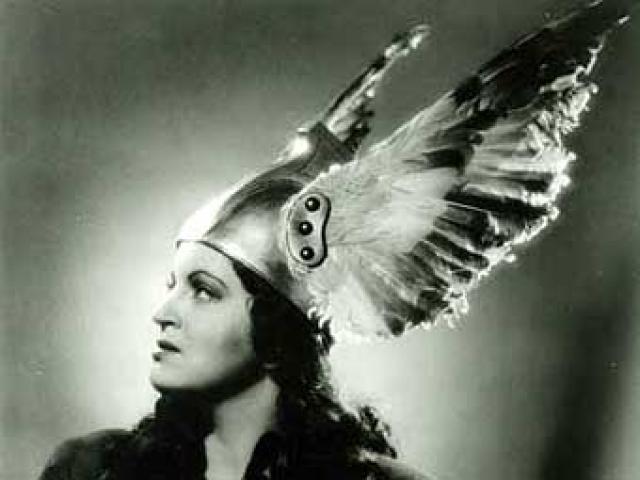
Astrid Varnay
 USA
USA- Astrid Varnay: A Legendary Soprano and Mezzo-Soprano
- Early Life and Education
- Metropolitan Opera Debut
- Wagnerian Repertoire
- Expanding Repertoire
- International Recognition
- Metropolitan Opera Departure
- Transition to Mezzo-Soprano
- Legacy
Astrid Varnay: A Legendary Soprano and Mezzo-Soprano
Astrid Varnay was an American soprano and later mezzo-soprano known for her powerful, dark-hued voice and her exceptional dramatic abilities.
Early Life and Education
Varnay was born in Stockholm, Sweden, to Hungarian parents. Her father, Alexander Varnay, was a tenor and stage director, while her mother, Maria Javor Varnay, was a coloratura soprano. The family moved to Argentina when Varnay was four years old, and later to the United States. She studied piano before her vocal talent was discovered in school. She received vocal training from her mother, Paul Althouse, and Herman Weigert, whom she married in 1944.
Metropolitan Opera Debut
Varnay's professional debut occurred on December 6, 1941, at the Metropolitan Opera in New York City. She unexpectedly replaced Lotte Lehmann as Sieglinde in Wagner's "Die Walküre." Her performance catapulted her to fame as a leading Wagnerian soprano.
Wagnerian Repertoire
Throughout her career, Varnay became synonymous with the operas of Richard Wagner. She was renowned for her interpretations of Sieglinde and Brünnhilde in "Der Ring des Nibelungen," Isolde in "Tristan und Isolde," and Kundry in "Parsifal."
Expanding Repertoire
While Wagner remained a central part of Varnay's repertoire, she also excelled in operas by Richard Strauss, Verdi, and Beethoven. Notably, she performed the roles of Salome, Elektra, and Marschallin in Strauss's operas, Lady Macbeth in Verdi's "Macbeth," and Leonore in Beethoven's "Fidelio."
International Recognition
Varnay's European debut took place in 1948 at the Royal Opera House, Covent Garden, in London. In 1951, she sang Lady Macbeth at the Maggio Musicale Fiorentino. She was invited by Wieland Wagner to perform at the Bayreuth Festival, where she appeared for 17 years in leading Wagnerian roles.
Metropolitan Opera Departure
In 1955, Varnay left the Metropolitan Opera due to disagreements with its director, Rudolf Bing. She subsequently performed primarily in Europe, particularly in Germany. She became a regular guest at the Stuttgart Opera, which was often referred to as the "Winter Bayreuth" due to its close association with the Bayreuth Festival.
Transition to Mezzo-Soprano
In the early 1970s, Varnay transitioned to the mezzo-soprano repertoire with great success. She retired from singing in 1995 after her final performance in Munich.
Legacy
Astrid Varnay's career spanned over six decades, during which she performed over 60 soprano and mezzo-soprano roles in operas from various composers. She possessed a remarkable voice that combined power and beauty, and she was known for her dramatic intensity and nuanced characterizations. Varnay collaborated with many legendary conductors, including Hans Knappertsbusch, Herbert von Karajan, and Fritz Stiedry. Her legacy as one of the most acclaimed opera singers of the 20th century continues to inspire generations of singers and music lovers.


