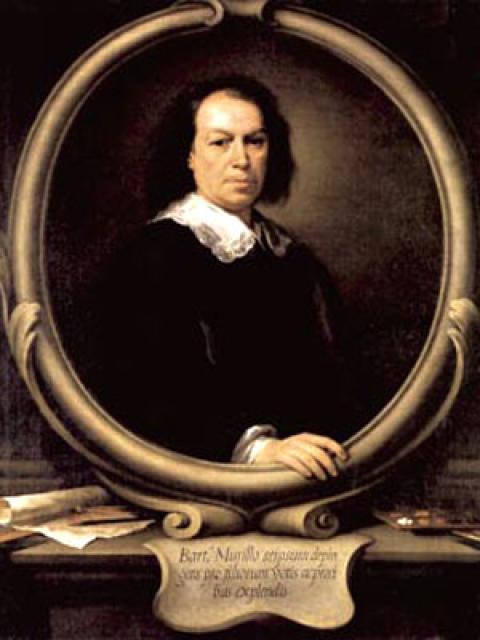
Bartolom (Esteban ) Murillo
 Spain
SpainBiography of Bartolome (Esteban) Murillo
Bartolome Esteban Murillo, a renowned painter and the pride of Spain, was born in Seville, Spain in 1617. He is considered to be the true representative of the Sevillian school of painting and the "head of Spanish colorists." Growing up as the fourteenth child in a modest barber's family, Murillo was orphaned at a young age and was raised by his sister and her husband, a surgeon. The family was relatively well-off, and they even sent him to study under a distant relative who was an artist. From there, he moved on to another teacher and eventually started thinking about how to see and study the paintings of great artists.
Unable to afford a trip to Italy, Murillo bought canvases and cut them into pieces. He spent day and night painting various scenes that caught his eye. He also started creating small images for the annual fair in Seville, where merchants would buy them to send to the New World to distribute to newly converted Christians. When Murillo had enough money, he decided to walk to Madrid instead of spending it on the journey to Italy. In Madrid, he crossed paths with Diego Velazquez, the court painter, who became his patron. Velazquez discouraged Murillo from going to Italy and instead introduced him to the treasures of the Escorial, where he could study the works of Titian, Rubens, Veronese, Raphael, Tintoretto, and other painters. Although there is no historical evidence of this trip, it is logical to include it in Murillo's biography as it symbolizes a turning point in his career.
Seville was a bustling city, with ships loaded with gold and silver from the New World arriving at its ports. Life in Seville was vibrant and lively, with people from different backgrounds and cultures mingling in the streets. Murillo thrived in this artistic atmosphere, surrounded by numerous workshops of painters, sculptors, and goldsmiths. In Seville, artistic thought developed more freely and independently, and the artists were closely connected to the people.
Murillo's first notable paintings, such as "Inspiration of the Monk," "Charity of St. Diego," and "Death of St. Clare," were created for the Small Monastery of St. Francis. Unfortunately, the monastery no longer exists today, as it was destroyed during renovations in the 19th century. However, it was once the largest monastery complex in the city during Murillo's time. The abbot of the Franciscan monastery wanted to decorate the walls with paintings illustrating the life of their order. The amount offered for 11 large canvases with life-size figures was modest, and no other artist wanted to take on the project. Only young Murillo, eager to prove himself, offered his services, and the Franciscans accepted.
The paintings caused great astonishment and admiration. No one could understand how this "unknown artist" could quickly grasp such a powerful and noble painting style. Soon, Murillo received numerous commissions and painted for various patrons. There was no cathedral, monastery, or significant private collection in Spain that did not own at least one work by the famous master.
According to his contemporaries, Murillo possessed a gentle, calm, and kind character. As an artist, he had unparalleled imagination and a sense of tenderness, grace, and awe, particularly when depicting religious subjects. He had a remarkable ability to portray the faces of Christ and the Virgin Mary, which evoked feelings of reverence in viewers. Murillo rarely dated his paintings, but whenever he did, it often marked an important event in his life. In 1652, while working on two paintings of the "Immaculate Conception," a significant turning point in his career, he decided to include the date. The year found him working on these two masterpieces, as he mostly glorified the Virgin Mary in his art.
In Spain, the image of Mary was synonymous with boundless kindness and power. During this time, King Philip III declared all his territories to be under the protection of the Immaculate Conception, which pre-empted the declaration of this dogma by Pope Pius IX in 1855 by two centuries. Of course, the creation of these famous madonnas was not solely inspired by this fact. Murillo always wanted to artistically explore a place in the Holy Scriptures where a woman dressed in the sun, with the moon under her feet and a crown of twelve stars on her head, appeared in the sky.
Most of Murillo's paintings depict the Madonna in a radiant glow, ascending among transparent clouds towards the heavens. Her gentle face, with moist eyes, cherry-red lips, tender and joyful expression framed by luxurious golden hair flowing over her shoulders, captivates the viewer. Her delicate and slender hands are usually crossed on her chest as if bearing a sense of excitement.
Murillo's iconography of Mary stands out for its unique characteristic. Although his depictions of the Madonna's face follow the canon, he never painted two Marys that looked alike. He varied her eyes – their shape, openness, and puffiness – her forehead – slightly sloping or straight – her nose – slightly longer or shorter, different wing shapes – her chin, and the roundness of her cheeks. This created the effect of multiple faces in one.
One of his earliest "Immaculate Conceptions" was commissioned by the Archbishop of Seville, indicating the growing reputation of Murillo. People began to trust his artistic vision and believed he would not make any mistakes. Murillo's devotion to his craft was evident when the monks who commissioned the painting for the main altarpiece of the Franciscan monastery saw the artwork up close and couldn't make out the formless mass of large, bold brushstrokes. They rejected the painting. However, at Murillo's insistence, they agreed to hang the painting in its intended place "as a trial." To their astonishment, they were greeted with an incredible beauty in both the central figure and all its details. In response, the artist punished them by agreeing to sell the painting again at double the original price. This incident made future critics more cautious in judging what they did not understand.
In the composition of the painting for the Franciscan monastery, the lower edge begins with shadows of varying depths. Just above the dense veil of clouds, a milky-white sphere appears. Shadows cascading onto the sphere from the clouds create a sense of independent movement in space. Pinkish-yellow angelic figures surround the sphere and the clouds, enhancing this impression. The Virgin Mary leans on a globe with her right foot, while her left foot is hidden behind a cloud, which acts as a support for the voluminous drapery of her dress.
The viewer's gaze irresistibly rises upward until it reaches the outstretched hands and the beautiful head framed by wind-blown hair. The tilt of her head redirects the movement downward, as Mary gazes into the distance, as if afraid of heights. The physical weight of her figure is emphasized by her dark cloak, the golden hues of which echo the folds of her white dress.
Murillo's approach to historical accuracy was not a priority in most of his paintings. He never attempted to depict an environment or nature that was completely unfamiliar to him, nor was he particularly interested in it. Based on the character of his own nature and the religious sentiment of the Spanish people, the artist believed that Spain was so similar to the Holy Land that all biblical events could have taken place there. Some of his fellow citizens were appalled by his liberty in interpreting sacred subjects, but their dissatisfaction did not overshadow his life as an artist.
Although Murillo could have had excellent models among the numerous Spanish Jews, he never thought of using them. Christ, the apostles, and especially the Madonna are depicted by Murillo as true Spaniards, not only in terms of their facial features but also in terms of their costumes. His Madonnas, such as "Annunciation," "Madonna in the Clouds," "Madonna with Rosary Beads," and "The Education of Mary," are beautiful Spanish women with lovely, delicate faces and fiery Spanish eyes. They are saints, but saints from this world. For example, "Madonna with Rosary Beads" undoubtedly belongs to the highest society of Seville, just like her lovely child.
This unique characteristic of Murillo's Madonnas, depicting them with strongly pronounced Spanish features, gradually developed to the point where some of his Madonnas evoke very specific associations. For instance, the famous painting "Gypsy Madonna."
The "Immaculate Conceptions" by Murillo are considered to be one of the pinnacles of the 17th century, rivaling Raphael's "Sistine Madonna" in the realm of art, according to the researcher of Murillo's works, Eduard D'Amigis. The Spanish people hold Murillo in such high regard that they pronounce his name with a smile, as if to say, "He is ours!" And when they speak of him, they demand respect from their listeners.




