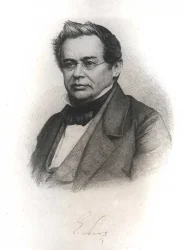
Benoît Paul Émile Clapeyron
- Education and early career
- Railways and engineering
- Making Carnot’s ideas visible
- Influence on thermodynamics
- Later years and legacy
Benoît Paul Émile Clapeyron helped turn the study of heat engines into a mathematical science. A French engineer and physicist, he gave Sadi Carnot’s ideas a clear analytical and graphical form, making them easier for other scientists to develop. His work became foundational to thermodynamics, while his practical career also helped build France’s early railways.
Education and early career
Clapeyron was born in Paris on February 26, 1799. He studied at the École Polytechnique, graduating in 1818, and continued his engineering training at the École des Mines. There he formed a lasting professional partnership with fellow engineer Gabriel Lamé.
In 1820, the two men went to Saint Petersburg, where they taught engineering and mathematics and worked on technical projects. They remained in Russia for about a decade, contributing to engineering education during a period when European states were investing in modern infrastructure. Clapeyron returned to France around 1831, as the railway age was gathering momentum.
Railways and engineering
Back in France, Clapeyron helped develop the country’s railway network. He worked on the line connecting Paris with Saint-Germain-en-Laye, one of France’s earliest railways, and contributed to other infrastructure and steam-engine projects. He brought a scientific approach to practical design, treating the behavior of heat and machinery as problems that could be analyzed systematically.
In 1844, he became a professor at the École des Ponts et Chaussées, France’s leading engineering school. His teaching and professional work linked the emerging fields of mathematical physics and civil engineering.
Making Carnot’s ideas visible
Clapeyron’s best-known scientific contribution came in 1834, when he published *Mémoire sur la puissance motrice de la chaleur* (“Memoir on the Motive Power of Heat”). The paper developed the ideas of Sadi Carnot, whose 1824 study of heat engines had received little attention during his lifetime.
Clapeyron translated Carnot’s largely verbal reasoning into equations and diagrams. In particular, he represented the Carnot cycle on a pressure-volume graph, allowing readers to see how a heat engine moved through a sequence of states. This graphical method made abstract thermodynamic ideas tangible to engineers and scientists.
The paper also set out relations among pressure, volume, and temperature for gases and analyzed the behavior of vapor as it changed between liquid and gaseous states. A relation derived from this work, describing how pressure changes along the boundary between phases, is now known as the Clapeyron equation. In a simplified form for vaporization, it is often called the Clausius-Clapeyron equation, after Rudolf Clausius later restated and developed it.
Influence on thermodynamics
Clapeyron’s careful treatment helped bring Carnot’s work to the attention of later physicists, including William Thomson, who became Lord Kelvin, and Clausius. Their subsequent contributions helped shape the laws of thermodynamics. Clapeyron worked before the modern concepts of energy conservation and entropy had been fully established, yet his mathematical framework gave later researchers tools they could extend.
His 1834 paper also combined empirical gas laws into an early equation of state for an ideal gas. The familiar modern expression was refined through later work, but Clapeyron’s use of mathematical relationships between measurable properties helped prepare the way for it.
Later years and legacy
Clapeyron continued to work as an engineer, researcher, and teacher. He was elected to the French Academy of Sciences in 1858, recognition of the importance of his contributions. He died in Paris on January 28, 1864.
His name remains attached to a central equation of phase-change thermodynamics, but his influence was broader than the formula alone. By giving Carnot’s insights a mathematical language and a visual form, Clapeyron helped make thermodynamics a field that could be taught, tested, and extended. His career joined the practical demands of railways and engines with the theoretical foundations of modern physics.