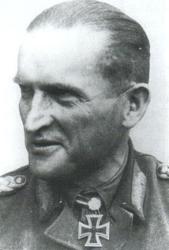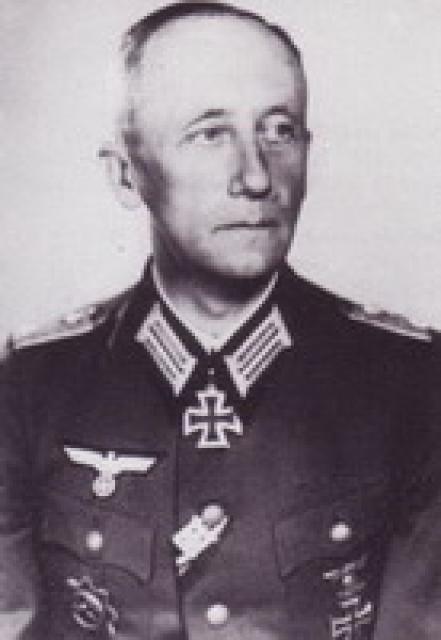
Bernhard Bechler
 Germany
- Bernhard Bechler: A Life in Conflict and Contradiction
- World War II
- Captivity and Anti-Fascist Activities
- Return to Germany and Political Career
- Military Rebirth in the GDR
- Retirement and Death
- Military Ranks
Bernhard Bechler: A Life in Conflict and Contradiction
Early Life and Military CareerBernhard Bechler was born on August 18, 1911, in Grünbach, Germany. His father was a chemical factory director, while his mother dedicated herself to raising the family's four children. After attending a private school in Langenfeld and the Realgymnasium Landesschule Dresden, Bechler decided to pursue a military career.
In March 1931, he joined the Reichswehr as a candidate officer in the 10th Infantry Regiment. As a lieutenant from October 1933 onwards, he served as a platoon commander. Subsequently, he commanded an anti-tank platoon in the 31st Infantry Regiment and acted as regimental adjutant in the 102nd Infantry Regiment.
World War II
At the outbreak of World War II in September 1939, Bechler initially served as an officer in various infantry divisions on the western front. In March 1942, he was promoted to major and sent to the Eastern Front as commander of the 1st Battalion of the 29th Motorized Grenadier Regiment.
Bechler's unit participated in the Battle of Stalingrad, where it was annihilated in January 1943. Not long before his capture on January 28, he was awarded the German Cross in Gold.
Captivity and Anti-Fascist Activities
Interned at a POW camp in Yelabuga, Bechler became involved in anti-fascist activities, disillusioned by the catastrophe at Stalingrad. He participated in the founding of the National Committee for a Free Germany (NKFD) in July 1943 and became a co-founder of the Union of German Officers.
As an editor and radio broadcaster, Bechler actively promoted anti-fascist propaganda among German soldiers, urging them to surrender and switch sides to the Red Army. He also conducted anti-fascist work in the trenches, addressing German troops directly.
Return to Germany and Political Career
Liberated from captivity in May 1945, Bechler returned to Germany and established an anti-fascist school near Stettin. He then moved to Brandenburg, where he played a key role in forming a new provincial government. Bechler joined the Communist Party of Germany (KPD) in July 1945, and after its merger with the Social Democratic Party of Germany (SPD), became a member of the Socialist Unity Party of Germany (SED).
From 1946 to 1949, Bechler served as Minister of the Interior of Brandenburg. However, his career was overshadowed by the imprisonment of his wife, Margret Dreikorn, who was accused of betraying a communist. Despite attempts to block her release, she was eventually pardoned in 1955.
Military Rebirth in the GDR
In September 1949, Bechler was dismissed as Minister of the Interior and embarked on a new military chapter in his life. Sent to the Soviet Union for training, he returned to the GDR in October 1950 and was appointed Chief of Staff of the Main Administration for Combat Training within the Ministry of the Interior.
On July 1, 1952, the GDR正式 established an army, and Bechler became Deputy Chief of Staff of the Kasernierte Volkspolizei (Peoples' Police). The appointment of former Wehrmacht Generalleutnant Vinzenz Müller as Chief of Staff dealt a blow to his ambitions.
Bechler became a collaborator with the Ministry of State Security (MfS), providing information on his colleagues. In 1953, he was promoted to Generalmajor of the National People's Army (NVA), established on March 1, 1956. He held various positions, including First Deputy Chief of the Main Staff and Head of the Operations Directorate.
After studying at the Soviet Military Academy of the General Staff from 1957 to 1959, Bechler became Head of the 2nd Faculty of the NVA's Military Academy. He later headed the Research Department of the NVA's Main Staff and the Institute for Mechanization and Automation of Troop Control.
Retirement and Death
Bechler retired on February 28, 1971, and lived until the age of 91, passing away in Kleinmachnow in 2002.
Military Ranks
- Chief Inspector: November 1, 1950- Major General of the NVA: October 1, 1952
Selected Awards
- Iron Cross 2nd Class
- Iron Cross 1st Class
- German Cross in Gold: January 28, 1943
- Order of the Patriotic War (USSR): March 1945
- Order of the Banner of Labor: 1960
- Honorary Buckle to the Order of Merit for the Fatherland in Gold