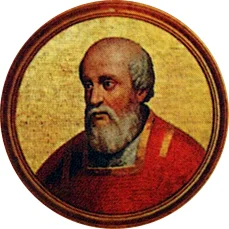
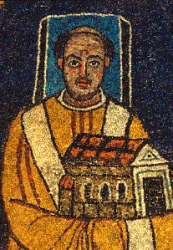
Boniface V
- A Neapolitan Cleric in Rome
- Churches as Places of Refuge
- Letters to Northumbria
- Final Years and Legacy
- A Quiet but Lasting Role
Boniface V guided the Roman Church during a period of limited surviving records but growing missionary activity beyond Italy. A native of Naples, he served as pope from 619 to 625. His name is associated with the protection of people seeking refuge in churches and with the developing Christian mission in Anglo-Saxon England, where he urged the Northumbrian king Edwin to consider the faith.
A Neapolitan Cleric in Rome
Little is known about Boniface’s early life. He came from Naples and rose through the Roman clergy before being elected after the death of Pope Deusdedit. A long vacancy separated the election from his consecration, which took place on 23 December 619. The delay reflected the close political oversight that the Byzantine authorities maintained over Rome, though the precise circumstances are not fully clear.
Boniface’s pontificate unfolded while the city remained part of the Byzantine Empire and while Rome’s bishops balanced local needs with imperial law. His records are sparse, so historians know more about a handful of church policies than about his personal life or wider diplomacy.
Churches as Places of Refuge
The Liber Pontificalis, a collection of papal biographies, credits Boniface with measures concerning sanctuary. These protections recognized churches as places where people pursued by authorities could seek refuge. The policy placed the church within the legal and social life of the city, setting limits on how secular officials could remove someone from a sacred space.
Boniface also directed church notaries to follow imperial law in matters involving wills and bequests. The instruction suggests an effort to keep ecclesiastical procedures aligned with the legal systems that governed daily life in Rome.
Letters to Northumbria
Boniface’s best-known international activity concerned the Christian mission in England. The historian Bede records that in 625 the pope wrote to Edwin, king of Northumbria, encouraging him to embrace Christianity. He also wrote to Edwin’s wife, the Christian princess Æthelburh of Kent, urging her to support the conversion of her husband and his people.
The letters formed part of a broader mission that involved Queen Æthelburh’s chaplain, Paulinus. Edwin’s eventual conversion took place in 627, after Boniface’s death, and helped establish Christianity more firmly in Northumbria. The episode shows how Rome’s authority and correspondence reached distant kingdoms through networks of churchmen, royal marriages and missionary work.
Final Years and Legacy
Boniface died on 25 October 625 and was buried in St Peter’s Basilica. His pontificate was not marked by a major council or a dramatic confrontation with rulers. Instead, he is remembered through practical legal protections and the support he gave to a mission whose effects continued after his death.
A Quiet but Lasting Role
Boniface V’s place in church history rests on modest but significant acts. The sanctuary measures protected the church’s role in Roman society, while his letters to Northumbria reveal the papacy’s interest in spreading Christianity beyond the former Roman world. His brief reign connects local governance in Rome with the formation of Christian kingdoms in early medieval Britain.