Paschal I
- A Roman Cleric Becomes Pope
- Churches, Mosaics and Relics
- Tension with the Carolingian Court
- Final Years and Legacy
Paschal I led the Roman Church from 817 to 824, during a period when the papacy was balancing spiritual authority with the power of the Carolingian emperors. He is remembered for rebuilding churches and relocating relics of martyrs into the city, as well as for a tense relationship with Emperor Louis the Pious. His pontificate shows how religious devotion, urban renewal and political negotiation were intertwined in ninth-century Rome.
A Roman Cleric Becomes Pope
Little is known about Paschal’s early life. He was born in Rome and trained within the city’s ecclesiastical institutions, eventually becoming abbot of the monastery of St Stephen. He was elected pope in January 817, immediately after the death of Stephen IV. The rapid election took place without waiting for the emperor’s representative in Ravenna to confirm it, reflecting Rome’s desire to manage its own succession while remaining within the wider Carolingian political order.
Paschal soon opened communication with Louis the Pious, who had become emperor in 814. In 817, Louis issued a document known as the Pactum Ludovicianum, reaffirming arrangements concerning papal territories and the rights of the Roman Church. The relationship was cooperative but not simple: the pope sought to protect Rome’s autonomy, while the emperor retained a strong interest in events within the city and the papal administration.
Churches, Mosaics and Relics
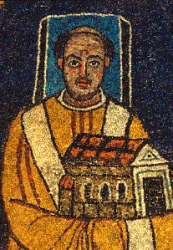
Paschal’s most visible legacy is architectural. He sponsored the rebuilding or decoration of several Roman churches, including Santa Prassede, Santa Maria in Domnica and Santa Cecilia in Trastevere. Their mosaics combine Christian imagery with carefully staged portraits of the pope and clergy, presenting Rome as both a sacred center and a community under papal care.
At Santa Prassede, Paschal created an important setting for the veneration of early Christian martyrs. Medieval accounts credit him with transferring the remains of many martyrs from catacombs outside the city into the basilica, helping protect and honor them. Tradition also links him to the relocation of Saint Cecilia’s relics to the church in Trastevere dedicated to her. These projects brought the memory of Rome’s persecuted Christians into prominent urban spaces and strengthened the city’s religious identity.
Tension with the Carolingian Court
Paschal maintained ties with the Frankish ruling family. In 823, he received Louis’s son Lothair in Rome and crowned him emperor, giving ceremonial weight to his role in the imperial succession. But his relations with the emperor were strained by factional conflict within Rome. Two papal officials were accused of conspiring with the Frankish party and were killed. Paschal denied responsibility and maintained that they had been guilty of treason, but the emperor’s investigators could not establish a resolution that satisfied all sides.
The incident exposed the limits of papal independence. Paschal could claim authority over Roman affairs, yet he still had to answer to a powerful ruler who regarded the city as part of his imperial order. His pontificate navigated that tension without a lasting break with the Franks.
Final Years and Legacy
Paschal died in Rome in 824 and was later venerated as a saint. His rebuilding projects left enduring marks on the city, especially the mosaics of Santa Prassede, which remain among the most striking works of early medieval Rome. His reign is also a reminder that medieval popes were not only religious leaders: they were patrons, negotiators and political actors working to preserve Rome’s place in a shifting European order.