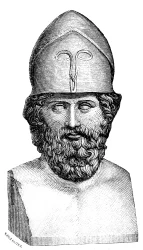
Cato the Elder
Cato the Elder was a Roman soldier, statesman and writer whose career spanned the middle years of the Roman Republic. Known for his austere public image and forceful speeches, he rose from a relatively modest background to the consulship and censor’s office. His surviving agricultural handbook is also one of the earliest substantial works of Latin prose.
From the Countryside to Public Life
Marcus Porcius Cato was born around 234 BCE at Tusculum, southeast of Rome. He served in the Second Punic War against Carthage and entered public life through military and civil offices. After serving as quaestor, praetor and consul, he was elected censor in 184 BCE. The office gave him influence over public morals, the Senate’s membership and state finances.
As censor, Cato gained a reputation for strictness. He criticized luxury and what he considered excessive personal display among Rome’s elite, and he used his office to enforce traditional standards of conduct. His political style was direct and combative, bringing him into conflict with powerful aristocrats and rival leaders.
Writer and Critic
Cato wrote on farming, public speaking, medicine and Roman history. His *De agri cultura* (“On Agriculture”), a practical work about managing an estate, is the only complete work of his to survive. His history *Origines* traced the beginnings of Rome and other Italian communities, but it remains only in fragments. Ancient writers also knew many of his speeches, most of which are now lost.
He is often described as an opponent of Greek influence, though his position was more complicated than a simple rejection: he learned Greek late in life and drew on Greek learning even as he warned that foreign customs could weaken Roman discipline. His writings helped establish Latin prose as a vehicle for practical instruction, history and political argument.
Carthage and His Legacy
Cato became a determined advocate for confronting Carthage after a Roman embassy he joined visited the city in 153 BCE. Later writers remembered him as ending his speeches with a call for Carthage’s destruction. The familiar Latin slogan “Carthago delenda est” is a later formulation rather than a phrase securely recorded in his own surviving words, but it captures the hostility attributed to him.
Cato died in 149 BCE, as the Third Punic War was beginning. Rome destroyed Carthage three years later. Remembered both for his political severity and his literary influence, Cato became an enduring emblem of republican discipline—and of the hard line Rome took toward its rival.