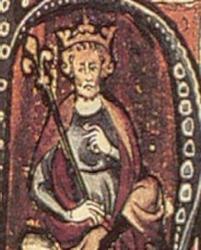
Christian III
 Denmark
- Early Life and Education
- Influential Encounters and Religious Views
- Succession to the Throne
- The Count's Feud and Triumph
- Lutheran Reformation and Consolidation of Power
- Foreign Influence and Asserting Danish Independence
- External Policy and Alliances
- Late Reign and Legacy
Early Life and Education
Christian III was born in Gottorf, Duchy of Schleswig-Holstein, on August 12, 1503, as the eldest son of King Frederick I of Denmark and his first wife, Anna of Brandenburg. Christian received his early education from Wolfgang von Utenhof, a renowned scholar from Wittenberg, and Johann Rantzau, a fervent supporter of the Reformation.
Influential Encounters and Religious Views
In 1521, Christian accompanied his father to the Diet of Worms, where he witnessed Martin Luther's defiant stand. From that moment, Christian became deeply influenced by Lutheranism. Upon his return to Denmark, he openly expressed his religious beliefs, clashing with the Catholic State Council and his father, King Frederick I.
Succession to the Throne
In 1526, Christian became Governor of Schleswig-Holstein and, in 1529, Vice-King of Norway. Despite his religious zeal, which antagonized the Catholic Church, he demonstrated exceptional administrative abilities. Following the death of his father in 1533, Christian's claim to the throne was rejected by the State Council in favor of his half-brother, Hans.
The Count's Feud and Triumph
The burgomasters of Copenhagen and Malmö, allied with Lübeck, backed the claims of Christian's deposed uncle, Christian II, sparking the "Count's Feud." Christian, with support from Jutland nobility and bishops, successfully campaigned in 1534 and regained control of the country after Copenhagen capitulated in 1536.
Lutheran Reformation and Consolidation of Power
Christian III seized the opportunity to implement Lutheran reforms. He carried out a coup d'état with German mercenaries on August 12, 1536, and dissolved the Catholic State Council. At the Copenhagen Diet in October 1536, he confiscated Church property and established a Lutheran state church. Despite opposition from Catholic bishops and Luther himself, Christian resolutely enforced his reforms.
Foreign Influence and Asserting Danish Independence
Christian's accession to the throne was marked by German influence, as he had relied on German nobles for support. A conflict arose between Danish nobles and German advisors, who sought to control the king. However, Christian's diplomatic skills and the threat from Emperor Charles V led him to favor Danish allies. In 1542, the Danish nobility granted a special tax to clear Christian's debts to German and Holstein creditors.
External Policy and Alliances
Christian III focused his foreign policy on forming alliances with German Protestant princes to counter the influence of Charles V, who supported the claims of Christian II's daughters to the Scandinavian thrones. Christian declared war on Charles V in 1542, and despite unreliable German allies, his blockade of the Sound proved effective, forcing Charles V to sign the Peace of Speyer in 1544.
Late Reign and Legacy
Following the peace treaty, Christian avoided foreign entanglements and played a mediating role between the Emperor and Saxony. He died in Kolding on January 1, 1559, and was buried in Roskilde Cathedral. Christian's reign of 23 years transformed Denmark into a Lutheran kingdom, established a strong central monarchy, and cemented the close ties between the Danish crown and the Protestant Reformation.